
Perfect Path Blog · Work Your Way · Workstyle Paths
Working Rotating Shifts: How the Schedule Works and What to Plan For
A job listing says “rotating shifts.” Before you say yes, make sure you know whether that means changing start times, nights, weekends, or all three.
Understand the Pattern → Check the Changeovers → Plan Real Life
Quick Answer
What does working rotating shifts actually mean?
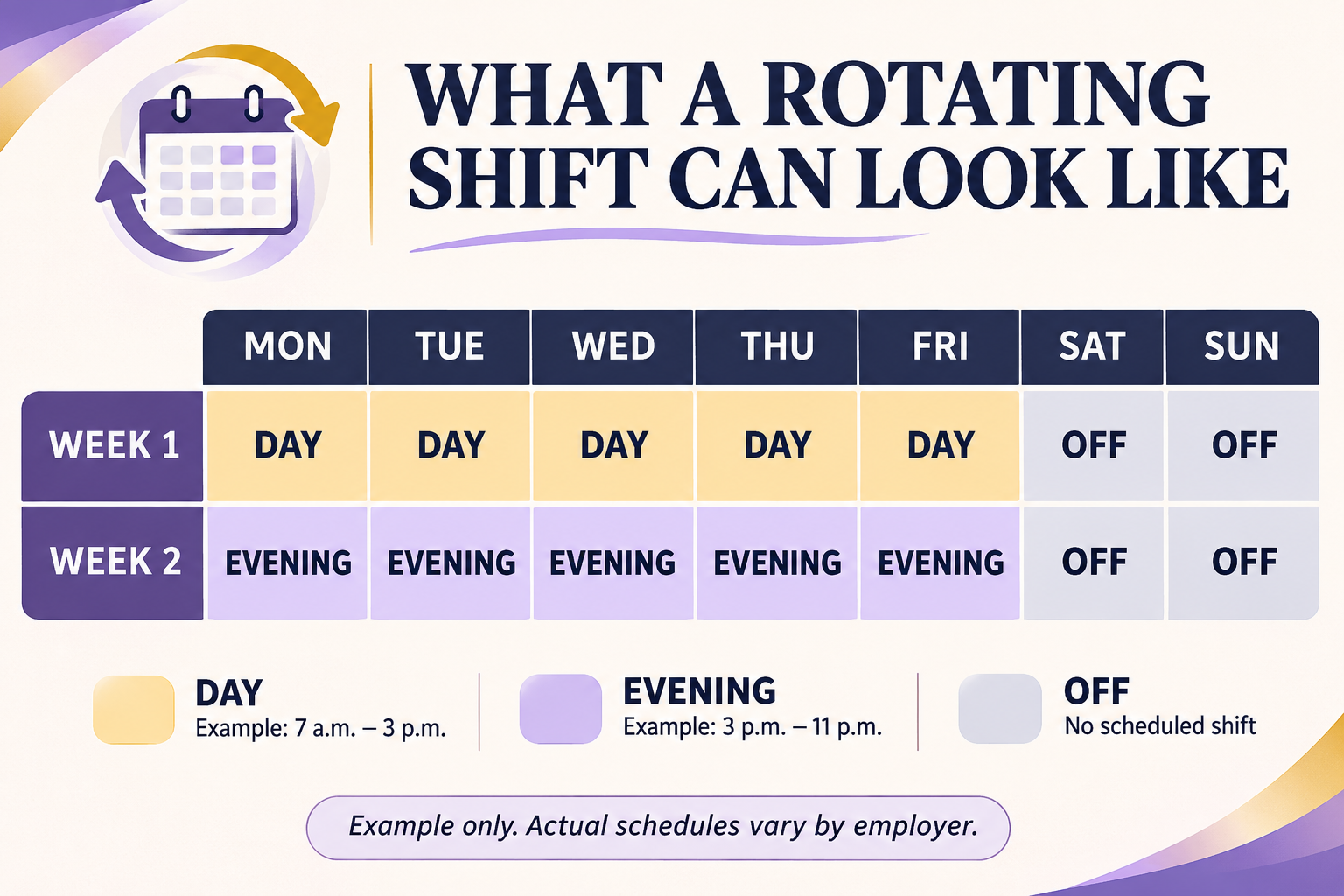
Working rotating shifts means your employer schedules you for different start and finish times according to a repeating pattern, instead of keeping you on one fixed shift. You might work 7 a.m. to 3 p.m. one week and 3 p.m. to 11 p.m. the next.
Some rotations include nights and weekends. Others don’t. Before accepting the job, ask for the full repeating schedule, including start times, end times, days off, how often the hours change, and the time between shifts.
No. Some jobs rotate between days and evenings only.
No. Hours and days off may rotate together or separately.
Yes. Weekly rotation is common, but other patterns exist.
A complete sample schedule showing the entire rotation.
Start Here
“Rotating shifts” can mean very different things
Imagine getting offered a job with good pay, decent benefits, and “rotating shifts required” tucked into the listing. That might sound fine. Then the schedule arrives and you discover you won’t have the same evenings free every week. Or you’ll be working overnight every third week.
Neither arrangement is automatically a deal-breaker. But they’re very different from working Monday through Friday at the same hours, and they can affect transportation, childcare, appointments, another job, or simply when you’re able to see people.
The good news is you don’t need to guess. Once you can see the full pattern, you can work out what the job is actually asking of you.
The Definition
What does a rotating shift mean?
A fixed shift generally keeps your start and finish times consistent. A rotating shift changes those hours on a recurring cycle. The work itself may stay the same even though the time you do it moves.
Example: You work 7 a.m. to 3 p.m. for one week, 3 p.m. to 11 p.m. the following week, and then return to the early shift. That’s a two-week rotation between days and evenings.
Some workplaces also rotate overnight shifts. Others alternate 12-hour shifts or move your regular days off. There isn’t one standard rotation everyone follows.
| Shift | Example hours | What that usually changes |
|---|---|---|
| Day | 7 a.m. to 3 p.m. | Early start, afternoon available after work |
| Evening | 3 p.m. to 11 p.m. | Afternoon and evening commitments may conflict |
| Night | 11 p.m. to 7 a.m. | Work crosses midnight; daytime sleep needs planning |
These are just examples. Ask for the hours your employer actually uses.
Know Your Schedule
Three common rotating shift patterns
Rotations differ most in how frequently your hours change. That detail matters more than whether the employer calls the schedule “flexible” or “standard.”
Weekly rotation
One week on days, then a week on evenings or nights. You can usually see the pattern coming, but your free time shifts every week.
Fast rotation
Shift times change within the same week. For example, two days, two evenings, one night, then time off. The changeovers deserve extra attention.
Slow rotation
You stay on one shift for two weeks or longer before switching. That can make a block easier to plan, although the transition still needs thought.
The National Institute for Occupational Safety and Health (NIOSH) describes the speed and direction of rotating schedules. Moving from days to evenings to nights is a forward rotation; going the other direction is a backward rotation. NIOSH does not identify one schedule as best for every workplace.
Don’t Mix These Up
Rotating hours are not the same as rotating days off
Job ads can make several arrangements sound similar. Here’s how to tell them apart.
| Term | What it usually means |
|---|---|
| Rotating shifts | Your start and finish times change as part of a repeating pattern. |
| Rotating days off | Your free days change, even if your work hours stay the same. |
| Rotating weekends | You work some weekends and have others off according to a pattern. |
| Swing shift | Usually afternoon into evening; it doesn’t necessarily rotate. |
| On-call | You’re expected to be available to work when called, subject to the employer’s policy. |
A job can combine these arrangements. You might rotate between day and evening shifts and work alternate weekends. Ask about each part separately.
Read the Real Schedule
Look at the changeover, not just the days you’re working
Two schedules can both say “five shifts a week” and feel completely different.
Suppose you finish at 11 p.m. Friday and start again at 7 a.m. Monday. That’s one situation. Finishing at 11 p.m. Thursday and returning at 7 a.m. Friday is another. Both can look like ordinary workdays on a calendar, but the time between shifts is nothing alike.
Also watch for shifts that cross midnight. If you work Sunday from 11 p.m. to Monday at 7 a.m., your work affects two calendar days, even when the workplace lists it only under Sunday.
Two weeks, four weeks, or longer? You need more than the first page of the roster.
Pay attention to late-to-early changes and overnight transitions.
A predictable start time doesn’t guarantee predictable days off.
A set rotation and a frequently changed roster create very different planning problems.
Find out whether overtime, last-minute coverage, or on-call duties are normal expectations.
Make It Work in Real Life
How to plan around rotating shifts without redoing your life every week
You don’t have to create a perfect calendar. Start by making the conflicts visible early, while you still have time to do something about them.
Put every shift on a calendar
Use exact start and end times. For overnight shifts, include the following morning so you don’t accidentally schedule over it.
Add what can’t move
School pickups, appointments, another job, transportation, caregiving, and standing commitments belong on the same view.
Flag the changeovers
Look for transitions from late finishes to early starts, shifts crossing midnight, and weeks when your usual sleep window changes.
Use the official roster as the source
Your personal calendar helps you plan, but check the workplace schedule for changes and follow its swap and notice rules.
Real-life example: You usually pick up your child at 4 p.m. Day shifts ending at 3 p.m. may work, but evening shifts starting at 3 p.m. won’t. Seeing the whole rotation lets you plan coverage or ask about shift options before the conflict turns into an emergency.
Transportation is another easy detail to miss. A bus route that gets you to a 7 a.m. start might not run when you finish at 11 p.m. Check the trip home as carefully as the trip to work.
Before You Accept
Seven questions worth asking about a rotating-shift position
You can be interested in the job and still ask for enough information to make a sensible decision. These are normal, practical questions.
- Can I see a full sample rotation? Ask for enough weeks to show the pattern repeating.
- Which shifts will I actually work? Days and evenings? Nights too? Twelve-hour shifts?
- How often do the hours change? Every few days, weekly, or in longer blocks?
- Will my weekends and days off rotate? Ask separately from the start times.
- How far in advance is the schedule posted? Also ask whether it can change after posting.
- How do shift swaps and availability requests work? Policies vary by employer.
- Are extra hours, on-call periods, or overtime expected? The published rotation may not tell the whole story.
How to ask naturally: “I’m interested in the role and I’m fine with different shifts. Could you show me what a full rotation looks like, including nights and weekends? I want to make sure I can plan around it reliably.”
If the employer can’t provide a complete example yet, ask what is fixed and what may change. That answer is still useful.
When the Schedule Doesn’t Fit
What if your rotating shift conflicts with something important?
Some conflicts have straightforward solutions. Others don’t. The best next step is to explain the specific problem rather than saying the schedule is impossible in general.
For instance, you might be available for mornings, evenings, and most weekends but need one particular night free for a standing caregiving responsibility. Ask whether the employer allows shift swaps, recurring availability requests, or a different rotation, and follow the stated process.
If the issue is not knowing your hours in time to arrange childcare or transport, focus on notice: “Would it be possible to have next week’s roster by Thursday? I need to confirm transportation.”
An employer may not be able to accommodate everything. But identifying the exact conflict helps you decide whether the arrangement is workable instead of spending weeks hoping it will somehow sort itself out.
A Better Decision
What to do once you’ve seen the full rotation
Look at a complete cycle, not just the hours you like best. Which weeks create conflicts? Are those occasional problems you can plan for, or recurring ones that would leave you scrambling every time?
Some people like rotating shifts because the changing hours open up different parts of the week. Others prefer the predictability of fixed hours. Neither preference tells you whether you’re good at your job.
If you’re trying to understand your broader working preferences alongside your job’s requirements, read How to Find a Workstyle That Fits You . This guide stays focused on what rotating hours actually mean and what to check before committing.
FAQ
Common questions about working rotating shifts
These answers help clarify what rotating schedules mean before you accept a job or make plans around one.
What does “rotating shifts” mean on a job application?
It usually means the job requires you to work different shift times as part of a repeating schedule. Ask which shifts are included, how often they change, and whether nights and weekends are part of the rotation.
Do rotating shifts always include nights?
No. Some jobs rotate only between early and late shifts. Others include overnight work or 12-hour day and night shifts. The employer’s complete schedule is the best way to confirm.
Is rotating shifts the same as working different days each week?
No. Rotating shifts change the time of day you work. Rotating days off change which days you’re free. Some jobs use both arrangements.
How often do rotating shifts change?
They may change within one week, weekly, or after two weeks or longer. NIOSH describes these as fast, weekly, and slow rotations, but individual employers use different patterns.
Are rotating shifts better than fixed shifts?
That depends on the schedule and your situation. Rotating hours may offer different free-time windows, but they can complicate sleep, commuting, or recurring commitments. Compare the actual pattern before deciding.
Next Path
Keep choosing by fit.
This article helps you understand rotating shifts and what to check before accepting a schedule. Next, follow the path that fits what you need.