Hobbies for Adults With Limited Time
Hobbies for adults with limited time work best when they are low-setup, short-session, and easy to pick up again.
Small Entry Point → Short Sessions → Real-Life Fit
Problem
Why hobbies for adults with limited time are hard to start
These hobbies for adults with limited time are built around one simple idea: the first step matters more than the perfect hobby category.
A lot of hobbies sound good until they meet a normal adult week.
Maybe the supplies are in another room. Maybe the setup takes too long. Sometimes the class time does not match your schedule, or the cleanup feels like a second task. By the time you could begin, the window is already gone.
That does not mean you are bad at hobbies. Instead, it means the hobby may be asking for more time, space, or energy than you usually have available.
Better starting point: look for hobbies that can begin quickly, stop cleanly, and still feel worth doing again.
Quick Answer
The best hobbies for adults with limited time have a small entry point.
Good hobbies for adults with limited time are not always the easiest hobbies. They are hobbies you can start without a big setup, stop without a big cleanup, and pick up again without feeling behind.
In other words, the best choice is usually the hobby you can begin in about 10 minutes, enjoy for 15 to 30 minutes, and make smaller when life gets full.
Fit Lens
How to choose hobbies for adults with limited time
The mistake is choosing hobbies by category only: painting, writing, gardening, photography, music, crafting.
However, those categories are too broad to be useful. A hobby can be easy or overwhelming depending on the version you choose.
For example, painting could mean a full easel, supplies, cleanup, and a long quiet afternoon. Or it could mean five postcard-size watercolor cards kept in one small tray.
Similarly, photography could mean expensive equipment and editing software. Or it could mean one phone photo prompt each day: light, texture, shadow, color, reflection.
So, the better question is not, “Is this a good hobby?” The better question is: What is the smallest real version of this hobby?
- Short setup: you can begin in about 10 minutes or less.
- Low cleanup: stopping does not create another task.
- Flexible timing: you can do it in a small window instead of waiting for a free day.
- Easy restart: missing a week does not make you feel like you failed.
How to Use This List
These hobby ideas are examples, not the only right answers.
Use the ideas below as patterns. The point is to see what makes a hobby easier to fit into a busy week: a smaller format, fewer supplies, a clear stopping point, or a version you can keep ready. If another hobby can be made that simple, it can work too. If your bigger issue is mental fatigue instead of time, start with Relaxing Hobbies for Adults Who Feel Mentally Tired.
Scattered Time
Short-session hobbies for adults with limited time
Some hobbies need a long, protected block of time. However, if that is not realistic right now, choose hobbies you can pause without losing your place.
- Embroidery hoop project: one small hoop is easier to keep going than a big craft project with many loose parts.
- Audiobook or podcast series: listen in short pieces while walking, cleaning, driving, or doing something repetitive.
- Recipe technique practice: learn one thing at a time, like better eggs, better rice, knife cuts, salad dressing, or roasted vegetables.
- Photo theme of the week: choose one theme and notice it all week, like shadows, color, texture, or reflections.
Small Progress
Small hobbies for busy adults who want progress
Progress does not have to mean a big project. Instead, it can mean one small skill becoming easier.
- One chord or song section: start with one chord change, one rhythm, or one small section of a song.
- One stitch or knot: learn one stitch, knot, fold, or pattern at a time.
- One drawing subject: draw only cups, trees, shoes, or windows for a week so progress is easier to see.
- One practical home skill: patch a hole, organize cables, fold a fitted sheet, clean a tool, or label one shelf.
If the bigger problem is not time but feeling blocked by the blank page, Creative Hobbies for Adults Who Don’t Feel Creative may be the better next read.
Be Careful With
What to avoid when choosing hobbies for adults with limited time
This does not mean you can never choose bigger hobbies. Instead, it means they may need to wait until you have more space, support, or rhythm.
- Heavy setup hobbies: anything that takes longer to prepare than to enjoy.
- Messy hobbies with no cleanup plan: the aftermath may start to feel like another chore.
- Expensive first steps: do not buy the identity before testing the hobby.
- Fixed schedules: classes can be great, but not if the time rarely fits your week.
- Hard restarts: if missing a week makes you feel like you failed, the hobby needs a smaller version.
For broader context, the National Institute on Aging notes that participating in activities you enjoy can support well-being as you age. Read more from the National Institute on Aging.
Small Test
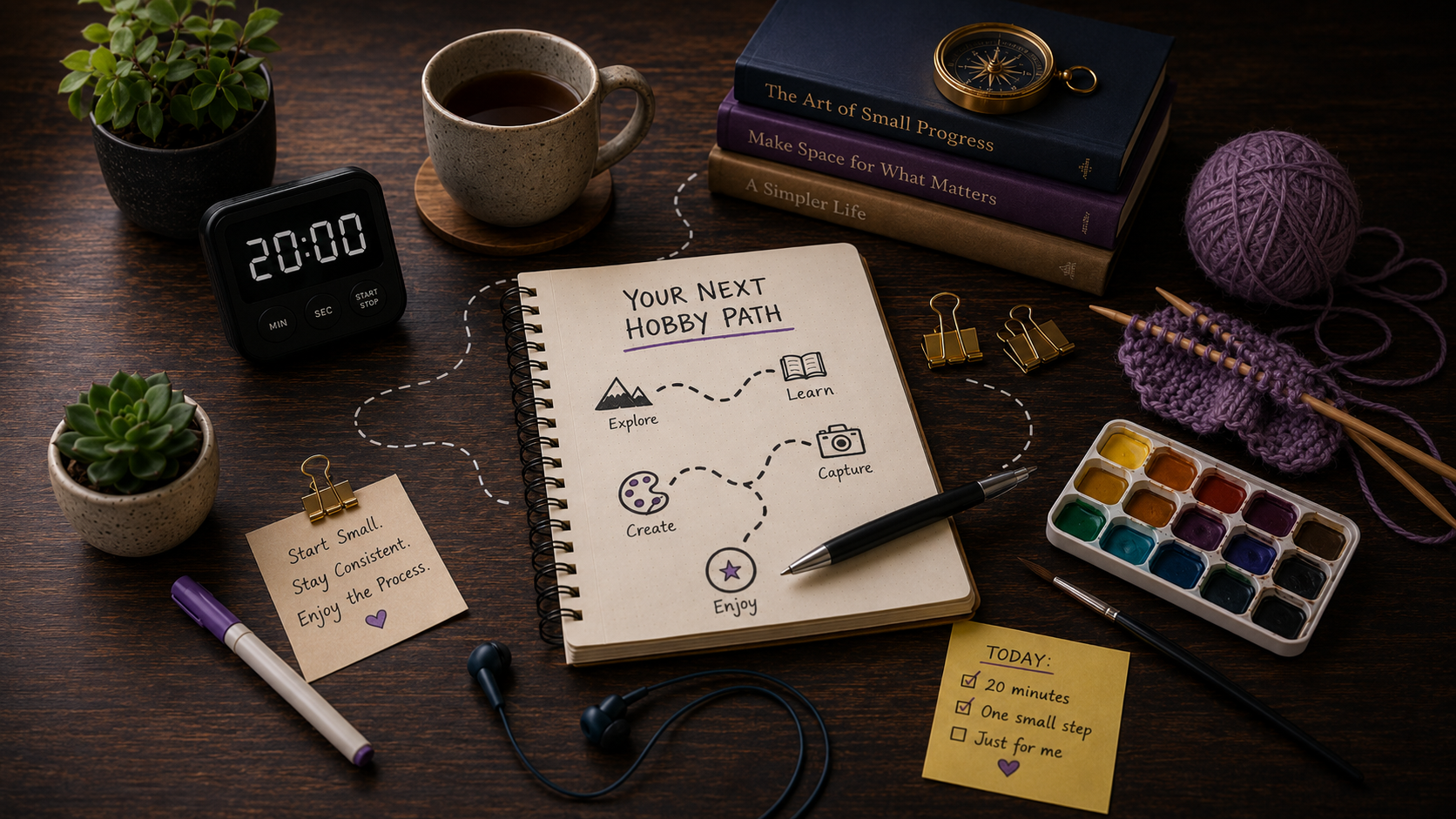
A 20-minute test for hobbies for adults with limited time
Do not start with a new identity, a shopping list, or a perfect weekly plan. Instead, start with one small test.
Choose the hobby version with the least setup, not the most impressive version.
Stop before it becomes a whole project. You are testing whether it fits, not proving commitment.
Was it easy to start, easy to stop, and something you would want to pick up again?
FAQ
Common questions about hobbies for adults with limited time
Use these questions to narrow the list without turning the decision into another project.
What hobby is best if I only have 20 minutes?
Choose a hobby with almost no setup and a clear stopping point. Good options include a pocket sketchbook, one-tray watercolor, audiobook walking, phone photography prompts, short writing prompts, puzzles, stitching, or a small practical skill.
What is the easiest hobby to start as a busy adult?
The easiest hobby is usually one that uses what you already have and can stay ready. Walking, reading, phone photography, sketching, and short audio learning are simple starting points, but the best choice depends on what usually gets in your way.
Should I choose a relaxing hobby or a productive hobby?
Choose based on what you need the hobby to give back. If your life feels overstimulating, choose calm. If you feel stuck, choose gentle progress. If you feel bored, choose novelty. The best hobby is the one you can keep coming back to without forcing it.
What if I keep quitting hobbies?
You may not be choosing bad hobbies. Instead, you may be choosing versions that are too big for your current life. Try a smaller starting point before dropping the hobby completely.