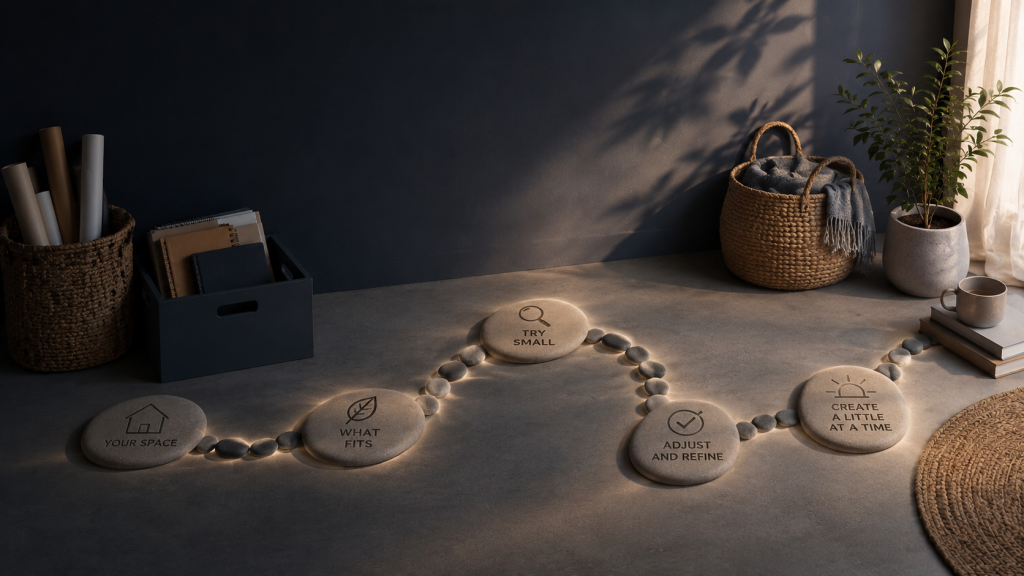
Creative Outlets for Adults Who Feel Burned Out
Creative outlets for adults work better during burnout when they do not ask you to perform, improve, or produce something impressive. Start with something gentle enough to enter when your energy is already low.
Lower Pressure → Choose Gently → Stop Before It Gets Heavy
Burnout Changes the Assignment
Creative outlets for adults need to ask less during burnout
Creative outlets for adults can feel surprisingly demanding when burnout has already drained your attention. Something that normally sounds enjoyable may become heavy once it involves choosing supplies, setting everything up, learning a skill, cleaning afterward, or deciding whether the result is any good.
However, that does not mean creativity is unavailable to you. It means the outlet needs to meet the energy level you actually have instead of asking you to push past it.
Right now, creativity does not need to become a new hobby, identity, side project, challenge, or habit. Instead, it can be one small place where your attention is not solving a problem for anyone.
A more useful question: What could I do for ten minutes that would feel a little lighter than everything else I have done today?
Quick Answer
The best creative outlets for adults with burnout ask very little
Look for something small, private if you need it, low-decision, and easy to stop. For example, a gentle outlet may help you empty a crowded mind, move an emotion, notice something beautiful, play without a purpose, or hold onto one small memory.
Most importantly, the outlet does not need to lead anywhere. It only needs to give you a few minutes that feel less demanding than the rest of the day.

Choose by What Feels Depleted
Choose burnout-friendly creative outlets by what you need most
Burnout does not always show up as simple tiredness. Sometimes your mind will not quiet down. At other times, you feel emotionally packed full. You may also be so tired of being useful that the thought of doing one more productive thing makes you want to shut down.
Therefore, start with the state that sounds most familiar. For a broader creativity-fit process, use How to Find a Creative Outlet That Fits Your Life.
Choose repetition, sorting, rhythm, or one very narrow theme. In this case, you need fewer decisions rather than more inspiration.
Choose something private that lets the feeling come out before you try to explain, edit, or make sense of it.
Choose play that has no practical outcome. Nothing needs to be posted, finished, improved, sold, saved, or turned into a lesson.
Choose an outlet based on noticing. Light, color, shape, sound, texture, or one small detail may be enough.
Choose one tiny container instead. One photo, one sentence, one song, one object, or ten minutes can still count.
Keep the outlet private for now. Removing the audience also removes explanation, metrics, and pressure to continue.
Use a preset rule, one repeated action, or one limited choice so you can begin without planning.
These low-pressure creative outlets are not another list to finish
You do not need to try every idea. Instead, pick the section that sounds closest to what you are feeling and test one option. When you have more room to look at the bigger picture, the Explore Creativity hub can help you choose where to go next.
Creative Outlets That Meet You Where You Are
Creative outlets for adults based on what burnout is taking from you
The goal is not to find the most interesting option. Instead, look for the one that asks the least from the part of you that already feels worn down.
Choose repetitive creative outlets that reduce decisions
A crowded mind rarely needs a wide-open creative prompt. Instead, it needs something with a clear rhythm. Repeating, sorting, arranging, or following one narrow theme gives your attention a place to go without asking it to invent a whole project.
Keep it light: Avoid anything that begins with “What should I make?” Otherwise, the outlet starts by giving your brain another problem to solve.
Choose private creative outlets that let emotion move
Emotional burnout can leave you carrying more than you have words for. Although you may want an outlet, the idea of explaining yourself to anyone can feel exhausting. Private, unfinished expression gives that pressure somewhere to go.
Nothing needs to be insightful or beautiful. In fact, the outlet may work better when it does not become a polished record of what you are going through.
Keep it honest: Do not make yourself clean up the feeling before it has had somewhere to go.
Choose creative play with no productive outcome
Burnout can turn every part of life into a transaction. You work out for health, rest so you can function tomorrow, organize to save time, and read to learn something.
Creative play interrupts that pattern. As a result, you get a few minutes that do not need to improve you or produce anything worth keeping.
Keep it playful: If you start planning a series, challenge, account, or finished collection, stop and shrink the idea again.
Choose creative outlets that help you notice beauty again
Burnout can flatten a day until everything looks like another task. A noticing-based outlet works differently because it does not ask you to create beauty from scratch. Instead, it helps you catch something small that was already there.
Keep it real: Do not turn the moment into a perfect aesthetic. The purpose is to notice beauty rather than prove you have good taste.
Choose tiny creative outlets with a clear ending
A project can feel heavy before you even begin because starting seems to create an obligation to finish. By contrast, a tiny container removes that pressure because you decide the edge before you start.
Protect the ending: Do not expand the container just because the first ten minutes went well. Stopping while it still feels light makes the outlet easier to return to.
Keep your creative outlet private until sharing feels good
Some creative outlets feel completely different once another person can see them. Suddenly, there is feedback, comparison, explanation, and the feeling that you should keep producing.
For that reason, you are allowed to keep something that nobody else gets to evaluate. Privacy can be part of what makes the outlet restorative.
Let it count privately: You do not have to share the outlet to make it real. If it gives something back to you, it already counts.
What Can Make Burnout Worse
Some creative outlets for adults quietly become another source of pressure
The activity itself may be fine. However, the problem often comes from everything that gets attached to it. Watch for anything that turns a small moment of relief into another responsibility.
- Too much setup Choose something you can begin in a few minutes with what you already have.
- Expensive supplies before you know it helps Test the smallest version first. Then, buy more only if the activity genuinely gives something back.
- A finished result you now owe yourself Choose an activity you can leave halfway without creating guilt.
- Turning the outlet into content Keep the first version off social media so you do not start planning photos, captions, or audience reactions.
- A mess you already dread cleaning Use one container, one surface, or something that can be put away in a single step.
- Comparison before you know what you enjoy Spend less time looking at other people’s work. Instead, notice how the activity feels while you are doing it.
- Emotional exposure before you feel safe Begin privately, indirectly, or with something you can delete or throw away.
- Another self-improvement plan The outlet does not have to make you more disciplined, skilled, calm, or productive every time.
Burnout can affect energy, focus, motivation, and emotional capacity. Creative activities may offer support, but they are not a substitute for addressing the conditions causing burnout or getting professional help when you need it. The American Psychological Association’s stress resources offer additional guidance.
Try One Small Thing
A 10-minute test for creative outlets for adults with burnout
Use this test before buying supplies, setting a schedule, or deciding that the outlet needs to become part of your routine.
Is it mental space, emotional release, play, beauty, privacy, energy, or your ability to handle projects?
Next, pick the easiest idea from the section that matches your current state.
Use one photo, one song, one voice note, one object, one page, or ten minutes.
Sharing can come later. First, find out whether the outlet helps when nobody else is involved.
Finally, notice whether you feel calmer, lighter, more present, more playful, or more pressured.
Example: If your mind feels crowded, spend ten minutes arranging colors or taking five photos of light. If you feel a little quieter afterward, the outlet is helping. On the other hand, if you feel judged, frustrated, or more tired, make the next version simpler or more private.
FAQ
Common questions about creative outlets for adults with burnout
Use these answers when you want something creative but do not have the energy for a demanding project.
What are good creative outlets for adults who feel burned out?
Good creative outlets for adults with burnout are small, private, low-decision, and easy to stop. For example, try taking one themed photo, making a short playlist, arranging colors, recording a private voice note, or writing one sentence.
What creative outlet is good for stress?
Repetitive and sensory outlets often work well for stress. Simple options include sorting colors, stitching, arranging objects, photographing one theme, or making a short mood playlist.
What if I am too tired to be creative?
Make the outlet smaller. You could notice one shadow, save one image, arrange one object, listen closely to one song, or record one short voice note.
Should I share my creative outlet?
You do not need to share it. Keep the outlet private when visibility adds comparison, explanation, feedback, or pressure to keep producing.
What is a low-pressure creative outlet?
A low-pressure creative outlet is easy to begin, does not require talent or a finished result, and can stop after one small action without creating another obligation.
How do I know if a creative outlet is helping?
Notice how you feel afterward. A helpful outlet may leave you calmer, lighter, more present, or less mentally crowded. If it leaves you feeling judged or depleted, simplify it.
Can creativity help burnout?
Creativity can give attention and emotion somewhere gentle to go. However, it should support recovery rather than replace rest, medical care, mental health support, or changes to the conditions causing burnout.
What should I avoid if I am burned out?
Avoid outlets with heavy setup, expensive supplies, difficult cleanup, public comparison, emotional exposure, strict improvement goals, or pressure to finish and share.
Next Path
Keep the next creative step small enough to feel possible
You do not need to solve your whole creative life today. Instead, choose the path that gives you the amount of direction you need next.