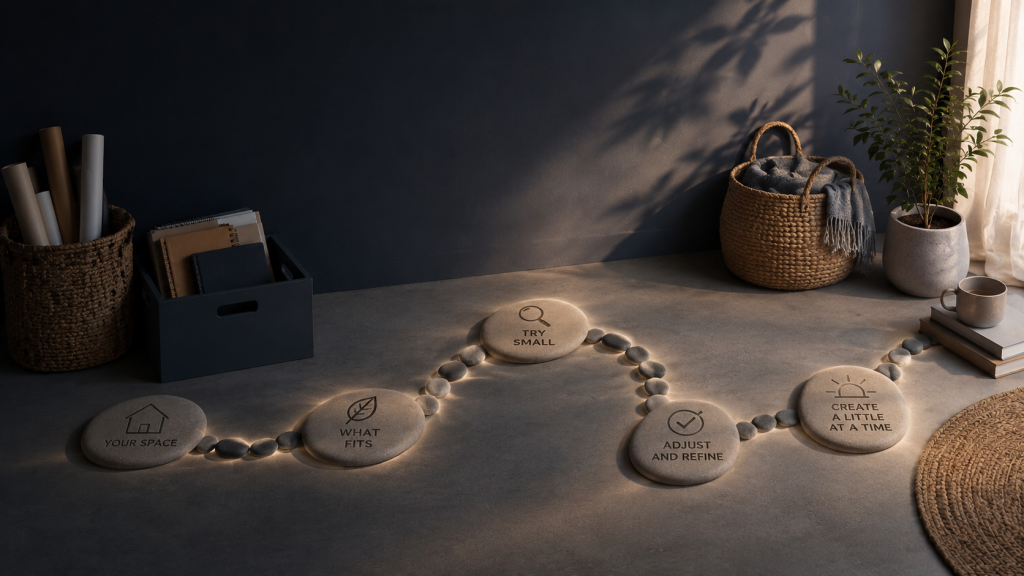
How to Find a Creative Outlet That Fits Your Life
A creative outlet does not have to prove you are talented. It should give your thoughts, energy, emotions, attention, or memories somewhere useful to go.
Instead of starting with painting, writing, photography, music, or another activity, start with a more useful question: what do I need creativity to do for me right now?
This guide will help you choose an outlet by its job, check whether it fits your real constraints, test one small version, and decide what to keep or change. If you still need a broader starting direction, visit the Explore Creativity hub.
Quick Answer
How do you find a creative outlet that fits your life?
To find a creative outlet that fits your life, start by naming what you need creativity to do for you. Choose whether you need the outlet to help you decompress, express feelings, make something tangible, notice beauty, process thoughts, play without pressure, or preserve memories. Then check whether the outlet fits your energy, privacy, space, attention span, and tolerance for imperfection before you test one small version. Research has also found that a short art-making session can reduce cortisol levels for many participants, although your outlet does not need to involve traditional visual art. Read the art-making and cortisol study.
Decide what you want the outlet to release, organize, create, notice, or preserve.
Look for qualities that match the job instead of choosing by popularity.
Compare the outlet with your real energy, privacy, space, supplies, and attention.
Use one short session to see what the outlet actually gives back.
Start here: complete the sentence, “I need a creative outlet that helps me ________.”

Start With the Job
Most people choose a creative outlet backward
People often begin with the activity: painting, journaling, photography, music, crafts, decorating, or writing. Then they try to make that activity provide calm, expression, play, clarity, or connection.
The activity is not the first decision; the job is. The same outlet can help one person and pressure another because they are asking it to do different things.
If you need calm, a detailed painting project may require too many decisions. If you need emotional release, a perfect-looking sketchbook may cause you to edit yourself before the feeling has somewhere to go.
“Should I paint, write, or take photos?”
This starts with activities before you know what result you need.
“What should feel different afterward?”
This helps you choose an outlet that can perform a useful job.
Ask what needs somewhere to go: stress, emotion, thought, restless energy, curiosity, playfulness, or memory. Then decide whether you need a useful result, a useful experience, or both.
Job-to-Outlet Map
Choose a creative outlet by the job you need it to do
Do not begin by searching for the most creative-looking option. Begin with the change you want the outlet to create in your real life, then look for the qualities most likely to produce it.
Decompress
For mental noise, overstimulation, or the transition out of a demanding day.
Repetitive, sensory, predictable, slow, low-decision, private, and easy to stop.
Example: ten minutes of repeating marks, simple stitching, color sorting, quiet music practice, or a slow photography walk.
Avoid outlets that require so many aesthetic choices that relaxation becomes another performance task.
Ask: Can I begin this when I am already tired?
Express feelings
For grief, anger, transition, identity questions, memories, or emotions that need a safe form.
Private, flexible, emotionally honest, and free from early judgment.
Example: private journaling, voice notes, messy art pages, movement, poetry fragments, music, or unsent letters.
Sharing too quickly can make you edit the feeling before you have processed it.
Ask: Would this still be useful if nobody saw it?
Make something tangible
For visible proof that an idea or piece of energy became a real object.
Hands-on, concrete, finishable, small, and proportionate to the available time.
Example: one handmade card, a tiny zine, a simple repair, a small clay form, or one page-sized visual piece.
Do not let every small idea expand into a large project or permanent workspace.
Ask: Can I complete one meaningful unit?
Notice beauty
For life that feels rushed, flat, visually dull, or disconnected from ordinary detail.
Observational, portable, everyday, sensory, and low-supply.
Example: color hunting, photographing light and shadow, collecting textures, visual walks, or noticing seasonal objects.
Do not turn noticing into a requirement to stage, improve, or publicly document everything.
Ask: Does this help me see more?
Process thoughts
For a mind that feels crowded, circular, fragmented, or difficult to organize.
Structured enough to sort ideas but flexible enough to stay honest.
Example: mind maps, visual sorting, voice notes, brain dumps, private essays, diagrams, or question pages.
Too much structure can turn reflection into a demand to solve everything.
Ask: Does the format help me see the thought differently?
Play without pressure
For boredom, over-seriousness, creative stiffness, or a life made entirely of useful tasks.
Short, experimental, disposable, surprising, and free from a required final product.
Example: one-color experiments, silly sketches, sound experiments, playful photo themes, or five-minute material tests.
Do not evaluate play by whether it created something worth keeping.
Ask: Can I do this badly and still enjoy it?
Preserve memories
For ordinary experiences, stories, places, recipes, or seasons of life you want to keep.
Record-based, personal, repeatable, gentle, and easy to maintain imperfectly.
Example: photo journals, one-line daily notes, family story recordings, recipe notes, memory boxes, or small collections.
Memory keeping becomes heavy when you feel responsible for documenting everything.
Ask: What small detail would I be glad to have later?
Constraint Check
Check whether the creative outlet fits your real life
An outlet can sound perfect and still be difficult to use. Before you commit, check what it asks from your energy, privacy, space, attention, supplies, cleanup tolerance, and emotional capacity.
The right job with the wrong setup can still feel like the wrong outlet.
Energy
The outlet needs peak focus or preparation when you usually reach for it while tired.
Create a low-energy version, such as five photos from one room instead of a full photography outing.
What is the tired-day version?
Privacy
Anticipating an audience changes what you make before the outlet becomes useful.
Choose the privacy level before you begin and store the work accordingly.
Would privacy make me more honest or relaxed?
Space
The outlet needs a surface, storage area, or dedicated setup you do not realistically have.
Fit the outlet into one pouch, shelf, box, folder, tray, or device.
Where will this live between sessions?
Supplies
Researching, buying, choosing, and organizing materials becomes the activity.
Start with one tool or one tightly limited material set before expanding.
Can I test the job before I expand the supplies?
Mess
Cleanup creates enough resistance that you avoid beginning.
Use a contained or dry-material version before choosing a setup-heavy medium.
Will the cleanup cancel the benefit?
Attention
The activity only feels worthwhile after a long uninterrupted block.
Choose a format with a natural stopping point after ten or twenty minutes.
Can I stop without ruining the session?
Imperfection
A rough result makes the whole session feel pointless before the outlet can help.
Choose a process that remains useful even when the result is unfinished.
What happens when the result looks rough?
Emotional weight
The outlet intensifies the feeling or creates rumination instead of release.
Shorten the container, change mediums, or follow expression with a grounding action.
Do I feel lighter, clearer, or more trapped afterward?
Pressure Pattern
Choose a creative outlet that avoids your usual pressure pattern
Your best outlet is not only the one that matches the job. It also needs protection from the pattern most likely to make you avoid it.
Choose the structure that removes your usual source of pressure before it has a chance to take over.
If you overthink
You spend more time deciding what to create than creating.
Use one limit: one color, one page, one object, one photo theme, one material, or one song. The limit removes decisions without removing creativity.
If you compare
You judge the result against other people before it has helped you.
Keep it private in a folder, camera roll, journal, voice-note archive, or sketchbook no one sees. Privacy separates usefulness from approval.
If you quit when it looks bad
An imperfect result makes the entire session feel like a failure.
Use process-based outlets such as repeating marks, rough drafts, movement, sound, texture tests, or experiments where appearance is not the point.
If supplies overwhelm you
Shopping, research, or organization delays the first session.
Use a one-tool outlet: one phone camera, one pen, one notebook, one app, one shelf, or one small box.
If emotion feels heavy
You begin expressing a feeling and immediately start judging or explaining it.
Choose release over performance through voice notes, unsent letters, movement, music, private writing, or non-display art.
If you get bored quickly
You enjoy beginning but resist returning after the activity feels familiar.
Use ten-minute sessions, one-photo walks, one-page formats, tiny collections, or rotating five-minute experiments.
Do you understand the job you need but still want concrete beginner-friendly ideas? Read Creative Hobbies for Adults Who Don’t Feel Creative.
One-Session Test
Test one creative outlet before you turn it into a new identity
Do not decide that you are becoming a writer, artist, photographer, musician, or maker before the outlet has proved useful. Test one specific activity in one small container and evaluate what it actually changes.
Decompress, express, make, notice beauty, process thoughts, play, or preserve memory.
Pick one activity, not a broad creative identity or complete system.
One page, one photo, one voice note, one object, one shelf, or ten minutes.
Private, semi-private, shared, or public. Decide before the session begins.
Stop before the test expands into a large project or new obligation.
Measure the result by what changed in you, not by how impressive it looks.
What did the outlet give back?
Example: if you choose decompression, test ten minutes of arranging one small shelf or taking five photos of light around your home. The point is not to produce impressive work. The point is to see whether the outlet gives your nervous system somewhere calmer to go.
Fit Decision
How to know if a creative outlet fits your life
The test is not a verdict on whether you are creative. It is evidence about the job, activity, setup, privacy level, and size of the container.
Use that evidence to choose the next honest move instead of forcing the outlet or abandoning creativity entirely.
Keep it
Use this when the outlet gives back what you came for and feels reachable enough to repeat. Keep the simple version before adding more tools, time, or complexity.
Shrink it
Use this when it helps but the format is too large. Turn long journal entries into three lines, or a full session into one ten-minute container.
Make it more private
Use this when exposure removes honesty, pleasure, or experimentation. Stop posting it and return the outlet to a private folder, notebook, or archive.
Change the container
Use this when the activity is right but the setup is too much. Reduce the tools, shorten the session, or fit it into one portable container.
Change the outlet
Use this when the job is right but the activity feels wrong. If drawing is stressful but noticing color feels good, move toward color collecting or photography.
Let it go
Use this when the outlet repeatedly asks for more energy, emotion, storage, money, or attention than it gives back. Releasing a poor fit is useful information.
Use the after-feeling as evidence.
Did the outlet perform the job I chose?
Could I begin without a major internal negotiation?
Did the setup match my real life?
What is the smallest adjustment worth testing next?
Did I like the experience, the result, or both?
Did the outlet give something back?
Pressure Warning
A creative outlet can add pressure before it helps
A creative outlet can stop being useful when performance, shopping, sharing, comparison, cleanup, or monetization enters too early.
Protect the outlet long enough to learn what it does for you before you ask it to impress anyone else.
Choosing what looks impressive
Choose by the private after-feeling the outlet creates, not by how artistic or interesting it appears from the outside.
Buying too many supplies
Test the outlet with one basic tool, a borrowed version, or materials you already own before building a collection.
Sharing before it feels safe
Make the first several sessions private by default so the outlet can become useful before an audience enters.
Turning it into a side hustle
Protect a period in which the outlet does not need to earn, grow, perform, become content, or justify its time.
Needing every result to look good
Evaluate the outlet by the job and the after-feeling rather than whether the result is display-worthy.
Choosing a cleanup-heavy project
Use a smaller container, fewer materials, or a lower-cleanup medium so the ending does not erase the benefit.
Comparing too early
Keep the beginning private and compare only whether the outlet is becoming easier, more honest, or more useful to you.
FAQ
Common questions about finding a creative outlet
Use these answers when you want creativity in your life but need the outlet to fit your actual energy, privacy, space, attention, and emotional capacity.
What is a creative outlet?
A creative outlet is an activity that gives thoughts, emotions, energy, attention, ideas, or memories a form outside your head. It can involve writing, movement, sound, images, objects, observation, arrangement, or documentation. It does not need to be public, polished, or traditionally artistic.
How do I find a creative outlet?
Start by deciding what you need the outlet to do. Choose whether you want to decompress, express feelings, make something tangible, notice beauty, process thoughts, play, or preserve memories. Then select an activity with qualities that match that job and test a small version.
What is a good creative outlet for stress?
A good creative outlet for stress is usually repetitive, sensory, low-decision, and easy to stop. Simple arranging, slow observational photography, repeating marks, quiet music practice, or another contained activity may help when it does not create additional performance pressure.
What is a good private creative outlet?
Private writing, voice notes, movement, photography stored in a personal folder, private audio experiments, and unseen visual work can all serve as private creative outlets. Choose a format that lets you be honest without anticipating an audience.
What if I do not feel creative?
You do not need to feel creative before using a creative outlet. Begin with a clear job and a small container. If you want concrete beginner-friendly activity ideas, read Creative Hobbies for Adults Who Don’t Feel Creative.
How do I know if a creative outlet fits me?
A creative outlet fits when it provides the result you wanted, feels reachable enough to repeat, and does not create more pressure than value. You should also be able to adjust its size, privacy, tools, or format to fit your life.
Can a creative outlet be simple?
Yes. A creative outlet can be one photograph, one voice note, one small arrangement, one page, one song, one object, or a ten-minute experiment. Simplicity often makes the outlet easier to use when you need it.
What if I try one and lose interest?
First decide whether the job was wrong, the activity was wrong, or the container was too large. You may need to shorten the session, change the tools, make it private, or choose a different outlet for the same need. You can also let it go without treating the test as a failure.
Next Step
You do not need to become more creative. You need one outlet that gives something back.
Finding a creative outlet gets easier when you stop choosing by talent, popularity, or how impressive the result might look. Start with the job you need creativity to do, check whether the outlet fits your real life, and test one small version before turning it into a larger commitment.
A creative outlet that fits does not have to become your identity, your side hustle, or something anyone else sees. It only needs to give your thoughts, emotions, attention, energy, or memories somewhere useful to go.
Keep the creative outlet useful.
- Choose the job you need the outlet to perform.
- Test the smallest version that still gives something back.
- Keep, shrink, privatize, change, or release it after the test.