What to Do When Your Routine Stops Working
When your routine stops working, it does not always mean you lost discipline. Sometimes your schedule, energy, responsibilities, or needs changed, and the routine has not caught up yet.
Notice What Changed → Keep What Helps → Change What No Longer Fits
Problem
A routine can stop working when your life changes
When your routine stops working, it can feel like you lost discipline, but the real issue may be that your life changed. A routine can be useful for a season, then start feeling heavy, pointless, or hard to reach because your schedule, energy, responsibilities, or needs no longer match the old version.
Often, the routine was built for a version of your life that is no longer current. Before you force the old routine harder, check what changed around it.
For example, a Sunday planning routine might have helped when weekends were open. If Sundays now include errands, family plans, or recovery time, the routine may not be broken. The old window may be gone.
Quick Answer
When your routine stops working, check what changed first
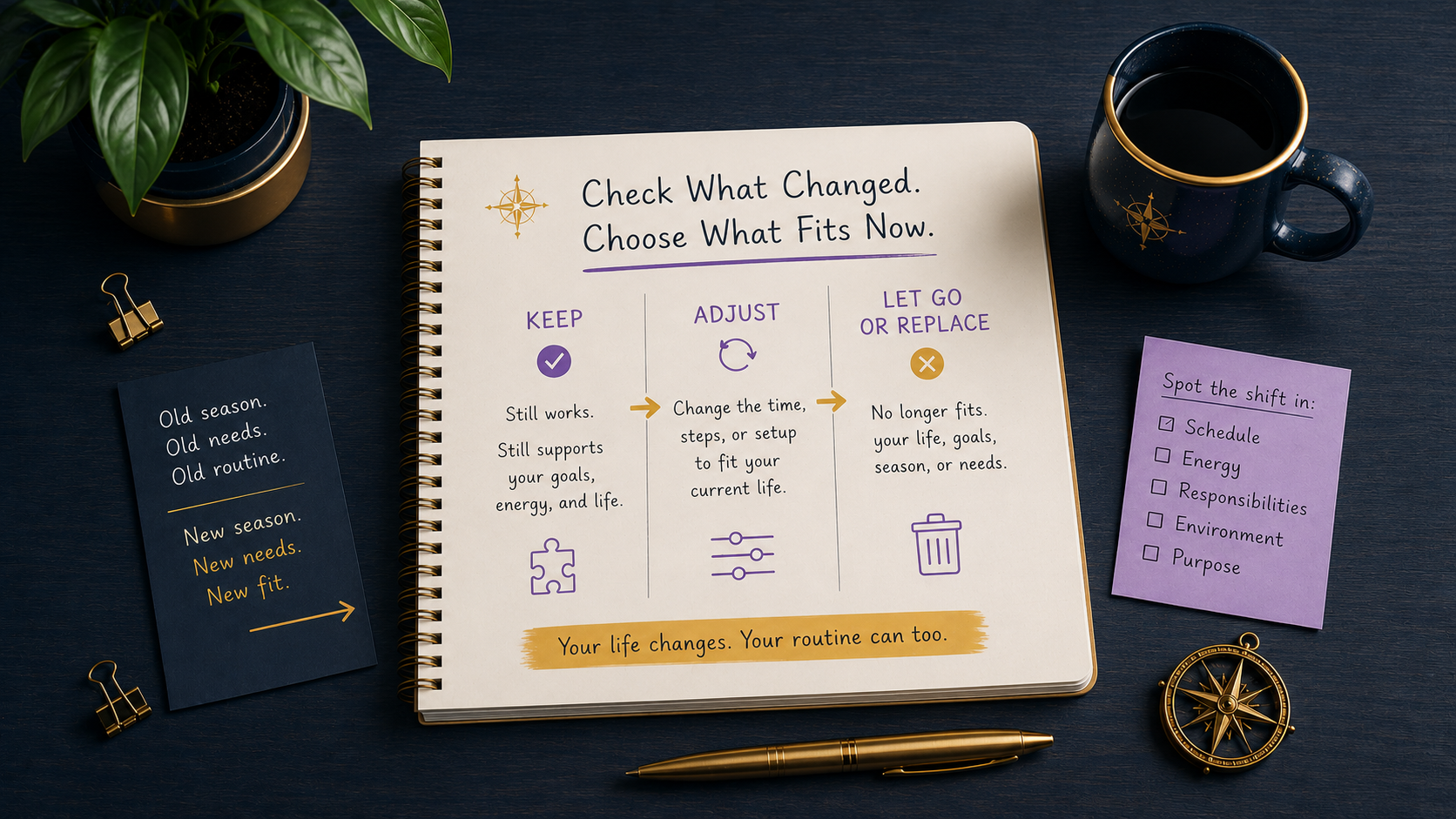
When your routine stops working, do not assume you need to start over. First check what changed: your schedule, energy, responsibilities, environment, or the problem the routine was meant to solve.
Then keep the part that still helps and adjust, move, replace, or retire the part that no longer fits.
Fit Lens
Find what changed before you change the whole routine
A routine that used to work can stop fitting for several reasons. The useful move is to diagnose the mismatch before you rebuild everything.
For the full routine system, start with Build Better Routines. This article stays focused on the specific moment when an old routine stops matching your current life.
The routine may still be useful, but the old time slot may no longer exist. Look for appointments, commute changes, family plans, later workdays, or weekends that no longer have the same open space.
The goal may still matter, but the routine may ask for more energy than you have right now. Notice whether the routine feels too physical, too loud, too long, or too decision-heavy.
New work, family, caregiving, school, or home demands may have crowded out the old version. A routine that once had room may now be competing with real responsibilities.
A move, room change, job change, new commute, or rearranged space may have removed the cue that made the routine easy to remember.
The routine may be solving an old problem instead of the pressure point you actually have now. What used to create clarity might now create extra work.
Some routines are seasonal. They help during one stretch of life, then become unnecessary when that season changes.
How to Use This List
These are routine mismatch signs, not personal failures
You do not need to force the old routine just because it used to work. You need to identify which part no longer fits the life you are living now. If a routine never really worked from the beginning, read Why You Can’t Stick to a Routine next.
Mismatch Check
What to check when your routine stops working
Start with the mismatch that sounds most familiar. Then change the smallest part that no longer fits instead of rebuilding the whole routine from scratch.
Move the routine before you abandon it
The routine still sounds useful, but you never seem to reach it at the old time. You keep saying you will do it Sunday, after work, before bed, or before leaving, but that window is now crowded.
The routine may still fit your life, but not in the same time slot. If the old window disappeared, forcing the routine into that spot will keep making it feel like a discipline problem.
Move the routine to a different anchor or window before replacing it. Try attaching it to an existing moment, such as after lunch, after the first coffee, after dinner, or before shutting the laptop.
Example: If your old Sunday planning routine stopped working because Sundays are now crowded, try Friday afternoon, Monday morning, or a shorter planning check after dinner instead of forcing it into the old spot.
Change the energy demand, not the whole goal
The routine still matters, but the full version feels heavier than it used to. You may still want the result, but the steps feel too loud, too long, too physical, or too hard to begin.
Your goal may still be right, but the routine may be asking for a version of your energy that is not available right now. The mismatch is the demand, not necessarily the desire.
Change the demand. Make it quieter, shorter, less physical, less decision-heavy, or move it to a better energy window before you decide the routine is over.
Example: If your after-work workout used to help but now feels impossible, the next version might be a walk, stretching, or workout clothes on plus five minutes of movement instead of the full plan.
Give the routine less space if your life is carrying more
The routine used to fit easily, but now it competes with new responsibilities. It may get interrupted, postponed, rushed, or skipped because another part of life now needs that space.
Caregiving, work changes, family schedules, school schedules, or home responsibilities can crowd routines that used to feel simple. The old version may need more room than your current life has.
Reduce the routine’s footprint. Keep the part that helps most and remove the part that requires space, privacy, quiet, or uninterrupted time your life does not have right now.
Example: If your old evening reset worked before your household schedule changed, the new version may need to become one useful closing step, like clearing one surface, instead of a full house reset. For more evening-specific help, use Simple Evening Routines That Make Tomorrow Easier.
Rebuild the cue if the old cue disappeared
You do not naturally remember the routine anymore, even though you still want it. The routine may only come to mind later, when you realize the moment already passed.
Routines often depend on environmental cues. A move, room change, job change, new commute, or rearranged space can remove the cue without you noticing.
Put the cue back where your day can see it. Place one object, note, tool, or setup in the path where the routine should begin.
Example: If your workout routine depended on seeing your mat in the living room, moving the mat into a closet may have removed the cue. The fix may be placing shoes, clothes, or the mat back in your normal path.
Check whether the routine still solves the right problem
You are still doing the routine, but it no longer makes the day easier. The routine may look productive from the outside while creating more lists, more prep, or more decisions.
A routine can outlive the problem it was created for. What helped last season may add friction this season if your current pressure point is different.
Name the pressure point the routine was supposed to reduce. Then ask whether that is still the real problem or whether the routine needs a new job.
Example: If your planning routine creates more lists but no more clarity, the goal may still be fewer decisions. The action may need to change from planning the whole week to choosing tomorrow’s first step.
Let the routine retire if it already did its job
The routine is not causing a major problem, but it no longer feels needed, helpful, or worth maintaining. You are keeping it mostly because it used to matter.
Some routines are seasonal. They help you through a specific problem, then become unnecessary once that season changes. Keeping them too long can turn support into obligation.
Do not keep the routine just because it used to matter. Keep the lesson, not the obligation. Decide whether the useful part can stay without the whole structure.
Example: If a strict evening routine helped during a stressful work season, but that season has passed, you may not need to keep proving you can do it. The routine may have done its job.
Be Careful With
Some reactions make an old routine feel even heavier
When a routine stops working, the first reaction is often to push harder. However, pushing the old version can make the routine feel heavier when the real issue is fit.
- Forcing the old version because it used to work: if the old time slot is gone, more discipline will not bring it back.
- Blaming yourself before checking what changed: the routine may be giving you information about your current life, not proof that you failed.
- Copying your old season into your new one: a routine from a lighter season may not fit a season with more responsibilities.
- Rebuilding the whole routine too quickly: change one part first so you can see what actually needed to move.
- Keeping a routine out of guilt: usefulness matters more than loyalty to an old version of your day.
- Treating every routine change like a failure: a routine can change because your life changed, not because the original routine was wrong.
- Adding more structure when the routine needs less: sometimes the next version needs fewer steps, fewer decisions, and a smaller footprint.
Stress and life changes can affect motivation, decision-making, and daily behavior. That is why it can help to adjust a routine instead of forcing the old version harder. Read the American Psychological Association’s stress overview.
Small Test
A 10-minute check for a routine that stopped working
Use this before you start over. The goal is to find the mismatch and make one useful change.
Choose one routine, not your entire day.
Was it reducing decisions, creating calm, keeping your home manageable, helping you move, or closing the day?
The old problem may have changed, or the routine may need a new purpose.
Look for a schedule, energy, responsibility, environment, or purpose mismatch.
Do not throw away the useful piece just because the full version no longer fits.
Make one decision about the part that no longer fits this season.
Example: If your weekly meal planning routine stopped working, ask whether the problem is still “I need a full meal plan” or whether the current problem is “I need two easy default dinners.” That changes the routine from a big planning session into a smaller decision reducer.
FAQ
Common questions about what to do when a routine stops working
Use these answers when you are deciding whether to keep, update, move, replace, or retire a routine that used to help.
Why did my routine stop working if it used to help?
Your routine may have stopped working because your schedule, energy, responsibilities, environment, or needs changed. The routine may have been built for a season of life that is no longer current.
How do I know if my routine no longer fits?
A routine may no longer fit if you keep missing the old time, the full version feels too heavy, the cue disappeared, or the routine no longer makes your day easier.
Should I change my routine or keep trying?
Change the routine if the same part keeps creating friction. Before you quit, try moving the time, reducing the steps, rebuilding the cue, or changing the routine’s purpose.
Can routines be seasonal?
Yes. Some routines are useful for a specific season, stress level, schedule, or responsibility load. When that season changes, the routine may need to change too.
Is it okay to stop a routine that used to work?
Yes. It is okay to stop a routine that no longer helps. Keep the lesson from the routine, then retire the obligation if it no longer fits your life.
How often should routines change?
Routines should change whenever your real life changes enough that the old version no longer fits. Review routines after schedule shifts, new responsibilities, moves, busy seasons, or major energy changes.
Next Path
Keep choosing by fit.
This article helps you adjust a routine that used to work. Next, use the path that matches what you need now.