Space Paths Guide
How to Improve Your Space Without Starting Over
Learning how to improve your space without starting over begins with one small point of friction, not a full makeover, expensive system, or complete reset.
Quick Answer
How do you improve your space without starting over?
To improve your space without starting over, do not begin by buying storage, emptying the whole area, or copying someone else’s setup. Start by watching where the space breaks down during normal use. Then make one physical change at the point of use, such as moving the most-used item closer, clearing one repeated landing spot, separating two jobs, or removing one blocker, and test it for a few normal days.
Do not buy storage before you understand what the area needs.
Keep the project inside a boundary you can finish.
Adapt ideas to your actual body, household, space, and use.
Make one physical change where the breakdown happens.
Use the area for three ordinary days before changing more.
Keep the Project Small
Improving your space gets harder when the project gets bigger than the problem
Most space problems start small. The mistake is turning one repeated problem into a full-room project.
One surface keeps collecting the same things. Perhaps a shelf is difficult to reach, or part of the car keeps filling up. Instead of changing that small point of failure, it is easy to decide the entire room, closet, cabinet, or car needs to be emptied and rebuilt.
That larger project creates more decisions, more displaced objects, more expense, and more unfinished work than the original problem required. As a result, the attempt to improve your space can make daily life harder before it makes anything easier.
Mail keeps collecting in one place
That does not always mean the kitchen needs an overhaul. The real problem may be that there is no easy point for deciding what to keep, toss, or handle.
Daily items are difficult to reach
That does not always mean the whole closet needs to be emptied. One shelf may simply be holding the wrong things in the easiest access position.
The same objects keep building up
That does not always mean the car needs a perfect organizing system. The objects may be missing an easy transition to the places they belong next.
Do not fix the whole space first
The first goal is not to fix the whole space. The first goal is to stop one repeated breakdown from happening the same way. Once that small point works better during normal life, you can decide whether anything else actually needs to change.
A bathroom counter repeatedly fills with the same three morning products. The answer may be a reachable daily-use area and a separate place for backups, not a bathroom makeover.
What small area keeps creating the same problem?
Before You Change the Space
Three common moves can make a small space problem harder
Buying storage, emptying everything, and copying a setup can all feel like progress.
However, each move can enlarge the project before you understand what is actually going wrong.
Pause before you add, empty, or copy. Let the real use of the area show you what needs to change.
Do not buy storage before you know what the space is asking for
The reader reaches for bins, baskets, trays, shelves, hooks, or labels before understanding why the area fails.
Storage can contain objects without fixing access, placement, decision-making, or competing uses. It may create a cleaner-looking version of the same problem.
Observe what repeatedly happens before buying anything. Use something you already own for the first test. Buy only after the area reveals the type, size, access, and placement support it needs.
A mail basket does not solve the lack of a keep, discard, and act decision point. A skincare bin does not help if daily items remain buried with backups.
A trunk organizer does not help if the car is carrying objects meant for several destinations and nothing makes the next destination easier.
Am I buying support for an observed problem, or buying before I understand the problem?
Do not empty everything if it will leave you with a bigger mess
The reader believes the project only counts if everything comes out first.
Emptying a large area creates immediate visual progress but also creates dozens of new decisions. When time or energy runs out, the unfinished project becomes harder to live with than the original problem.
Choose the smallest physical boundary that can be fully completed. Work on one shelf, drawer, counter section, cabinet zone, bag pocket, car area, bedside surface, or shared landing spot.
Rather than emptying an entire closet, work only on the shelf blocking access to everyday items. Remove objects that do not belong in that use zone and test the shelf before touching the rest.
The boundary should be small enough that you can finish it, return the area to use, and avoid creating a displaced pile somewhere else.
What is the smallest boundary I can fully finish today?
A space can look good online and still fail in your real life
The reader copies a visually appealing setup created for a different body, household, schedule, rental, or level of maintenance.
The setup is optimized for someone else’s movements and preferences. It may require opening lids, sorting carefully, reaching too high, folding precisely, or resetting more often than the reader realistically will.
Observe the real use pattern. Borrow the underlying idea, not the exact setup. Adapt the access, visibility, placement, and reset steps to the people who actually use the area.
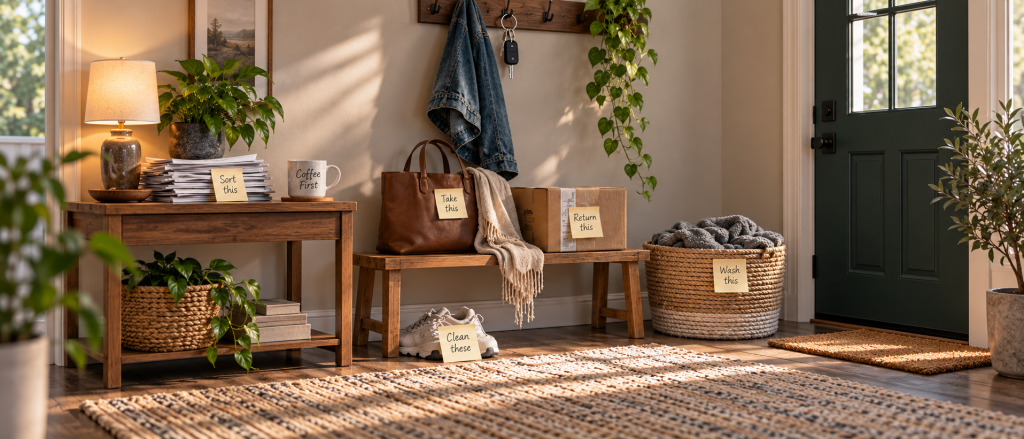
An entryway with closed, labeled baskets may photograph well. However, if everyone drops bags on the floor and ignores lids, open hooks or one visible shelf may be the better fit.
It still needs to work when people are tired, rushed, carrying several things, or using the space differently from one another.
What part of this setup fits my life, and what part only looks appealing?
Find the Point of Use
Improve your space by finding where it actually gets used
The point of use is where real life meets the space. It is where a hand reaches, an object lands, a person unloads, a pile begins, or the next action becomes inconvenient.
This matters because people often improve the place where an item is supposed to live instead of the place where the breakdown actually happens.
Watch the area during normal use, not only while you are cleaning it.
Where items naturally land
Landing point
Notice the first surface, shelf, seat, pocket, or floor area that receives the object.
Example: Keys repeatedly land on the first kitchen surface after entering, even though their assigned drawer is farther away.
Where you stand or sit
Body position
Look at where your body is when the object is used, returned, unloaded, or searched for.
Example: A bathroom item may be stored neatly across the room even though it is used beside the sink every morning.
What you reach for first
Daily access
The most frequently used item may need the easiest position rather than the most visually hidden position.
Example: Daily medication should not sit behind bulk refills, travel supplies, or rarely used items.
What must be moved first
Physical blocker
Watch for anything that must be lifted, shifted, opened, unplugged, or removed before the useful item can be reached.
Example: Backup towels block the supplies used every day, so the problem is access rather than a lack of cabinet space.
What you avoid because it is annoying
Friction point
An awkward lid, deep shelf, high hook, crowded pocket, or complicated return step can quietly change how the area gets used.
Example: An item stays out because putting it away requires opening a cabinet, moving another object, and reaching behind it.
Where the pile begins
First breakdown
Do not study only the final pile. Notice the first object and the first interrupted action that starts it.
Example: Clean laundry remains in a basket because folding and putting it away require too many separate steps.
Where a transition stops working
Next destination
Some clutter is not a storage problem. It is evidence that objects have no easy next move between one place and another.
Example: The car passenger seat becomes storage because unloading at home has no easy next destination.
How another person uses it differently
Shared use
A shared area can fail because different people reach, unload, return, or identify ownership in different ways.
Example: One person hangs a bag while another drops it near the door, so the setup needs to support both real movements.
Where does the space break during use, not during cleanup?
Change the Use Point
Improve your space with one physical change where the problem happens
Once you know where the breakdown happens, choose one physical change that makes that point easier to use.
The goal is not to reorganize everything around it. The goal is to remove one repeated step, conflict, or obstruction and see whether normal use gets easier.
Make only one change for the first test. When several things change at once, it becomes difficult to tell what actually helped.
Choose the smallest physical adjustment that could change what happens at the use point without rebuilding the entire area.
Put the item where the action already happens
Move the object closer to the place where it is used, loaded, unloaded, or returned instead of expecting yourself to carry it to a more traditional storage location.
Example: Move a device charger into the bag pocket where the device is actually stored.
Give one object group a clear physical limit
Create a small, defined area so one type of object stops spreading into every nearby pocket, surface, seat, or shelf.
Example: Give receipts one section inside a bag instead of letting them collect across several pockets.
Remove one job from an overloaded area
If one small space is being asked to support several unrelated uses, relocate one of them rather than trying to fit everything more tightly.
Example: Keep one part of a car console available for items needed during regular trips instead of using it for long-term storage.
Separate a shared area by person or use
Make it obvious which section belongs to which person, destination, or task so objects are not continually moved, mixed, or searched for.
Example: Divide one shared landing area so each person has a clear place for the things they carry in and out.
Keep objects used together in the same reachable zone
Bring related supplies together so the activity does not require searching across several shelves, drawers, pockets, or storage points.
Example: Keep the basic supplies for a creative corner on one reachable shelf instead of scattering them across the room.
Create a destination for things that are leaving
Some repeated piles are waiting for another trip, person, room, or destination. Give those objects one temporary outgoing place tied to their next move.
Example: Create one outgoing spot for returns, donations, borrowed items, or things that need to leave with you.
Make the change easy enough to survive normal life
The best first change is often simple and visually unremarkable. It should require less reaching, carrying, sorting, remembering, or explaining than the current setup.
The change should make the useful action easier than the old workaround. If it adds several new steps, it is likely to become another system that only works when the area has just been reset.
What single physical change would remove one repeated step, conflict, or obstruction?
Test Normal Life
The best space fix is usually boring enough to maintain
A solution can look clever, organized, or attractive and still be too difficult to keep using.
Every added lid, fold, label, sorting rule, lifting step, or explanation creates another place where the setup can fail when someone is tired or rushed.
Prefer the least complicated change that consistently supports real use.
The fix should be easier than the old problem
An open tray may work better than a beautiful closed basket during a rushed transition. A visible hook may work better than a hidden drawer. A plain divider may work better than a detailed labeling system.
The less impressive option may be the more durable one. What matters is whether the space remains easier to use after the fresh reset is gone.
Can the setup still be used when you are tired, distracted, or in a hurry?
Can another person understand where something goes without needing instructions?
Can the item be returned in one easy movement rather than several separate steps?
Does the change remove effort instead of adding another action to remember?
Is the object needed most often now easier to reach, see, use, or replace?
Does the setup still help when the area is being used and is not freshly cleaned?
Test the change before you keep changing things
A staged space has not yet encountered rushed mornings, incoming objects, shared use, low energy, or the ordinary movement of daily life. Use the area normally for three days before deciding what should happen next.
Watch the first use
Notice whether the change affects how you reach, unload, return, move through, or begin using the area. Do not remind yourself to perform the new setup perfectly.
Watch what starts returning
Look for the first sign of the old pile, obstruction, search, or competing use. The point is to see whether the original breakdown has actually changed.
Watch the reset
Check whether the area is easier to restore after ordinary use and whether another person uses the area differently from the way you expected.
Did I search less?
Did I move fewer objects out of the way?
Did the same pile return?
Did the change create a new problem?
Did another person use the area differently?
Was resetting the space easier?
Did the area become easier to enter, use, or maintain?
Did the change still help when the area was not freshly cleaned?
Example: A mail tray is tested for three days. Paper still spreads across the counter because the mail is serving several different jobs. Some pieces are trash, some require action, some belong to another person, and some need to stay visible. The next change should separate those uses rather than simply adding a larger tray.
What happened after real life touched the space again?
After the Test
Decide what the space needs next
After three ordinary days, you should have more than a clean-looking result. You should know whether the change made the area easier to use.
The next move depends on what actually happened. Sometimes the first change is enough. Sometimes it needs one adjustment. Sometimes the test shows that the object, activity, or setup belongs somewhere else entirely.
Use the result to choose one next move. Do not restart the whole project.
Keep it as it is
If the area became easier to use and the change survived ordinary life, leave it alone.
Example: One open pocket in a work bag keeps the charger easy to find and return. There is no reason to buy a larger organizer or redesign the rest of the bag.
Adjust the same change
Keep the basic idea and change only the part that remained awkward, crowded, difficult to see, or hard to return.
Example: A tray keeps frequently used studio tools together, but it is too deep to see what is inside. A shallower tray may solve the remaining problem without changing the entire setup.
Accept the location it naturally chooses
If an object repeatedly returns to another place, that may be useful information rather than bad behavior.
Example: Reusable shopping bags stay in the car because that is where they are needed. Keeping them there may work better than repeatedly carrying them back inside.
Split one mixed use into two
When unrelated activities keep competing for the same small area, stop trying to make them coexist more neatly.
Example: A shared tabletop cannot stay clear because it holds active work, incoming papers, and devices waiting to charge. Move one of those jobs somewhere else rather than adding more containers.
Remove it instead of improving it
Some objects, supplies, systems, or activity zones remain difficult because they no longer support anything important.
Example: A rarely used collection takes the easiest shelf in a small apartment while everyday supplies remain difficult to reach. The better move may be to reduce, relocate, or release the collection.
Keep it, adjust it, accept the real location, split the competing uses, or remove what no longer deserves the space.
Useful Guardrails
What not to do when you want to improve your space
Once you notice a frustrating area, it is easy to rush toward whatever looks like progress.
Some of those moves make the space look different without making it easier to live with, carry, use, move through, or maintain.
Watch for the shortcut that quietly creates a second problem.
Buying storage first
You commit to a container before you know whether the problem is access, location, volume, visibility, or something that does not belong there.
Test the needed location and boundary with something you already have. Buy only when you know exactly what the support needs to do.
Emptying the whole area
A manageable annoyance becomes a field of loose objects and unfinished decisions that can no longer be ignored.
Choose a boundary you can finish and return to use that day, even if it is only one shelf, pocket, seat, drawer, or surface section.
Copying the setup exactly
You inherit someone else’s reach, habits, schedule, household rules, available space, and tolerance for upkeep.
Borrow the useful idea, then change the placement, access, visibility, and reset steps to fit the people who will actually use it.
Decorating over the friction
The area may look more finished while the awkward reach, blocked movement, uncomfortable position, or competing use remains exactly where it was.
Fix the physical annoyance first. Add visual finishing touches only after the area works better during ordinary use.
Organizing only by category
Similar objects sit together neatly, but the ones needed most often may end up far from the action or buried behind the rest of the category.
Let use and access outrank category. Keep the active item or group where it earns the easiest position.
Hiding daily-use items too well
The area looks calmer when reset, but ordinary use now requires extra opening, searching, reaching, or remembering.
Keep what is used regularly easy to reach. Reduce the unrelated objects around it instead of treating all visibility as clutter.
Building a high-maintenance fix
The space only works when everything is folded precisely, sorted into several groups, placed behind lids, or reset with more care than daily life allows.
Choose the version that still works when you are tired, rushed, distracted, carrying things, or sharing the area with someone else.
Changing the test halfway through
You keep moving, adding, and adjusting before any one version has faced enough normal use to show you what actually works.
Leave one change in place for the full test unless it creates an immediate safety or access problem. Then use the result, not impatience, to choose what happens next.
Before adding another step, ask whether it makes the space easier to use or only makes the solution look more complete.
FAQ
Common questions about how to improve your space without starting over
These answers cover the practical questions that usually come up when you want one area to work better without turning it into a full makeover or major organizing project.
What is the easiest way to improve your space?
The easiest way to improve your space is to choose one small area that causes the same problem repeatedly and change one physical thing there. Focus on the exact place where you reach, unload, search, pause, or put something down rather than trying to improve the whole surrounding space.
How do I improve my space without buying anything?
Start by moving, removing, or separating what is already there. You might move a frequently used item closer, clear one landing spot, move backups out of the easiest-access position, or use a container you already own while you test the change.
Should I declutter before I organize?
Not necessarily. First look at why the area is difficult to use. If the problem is poor access, the wrong location, or two uses competing for the same space, removing random objects may not solve it. Reduce only what blocks the area’s real job or clearly does not belong there.
What should I fix first in a small space?
Fix the point that creates the most repeated effort. That may be one crowded bag pocket, one hard-to-reach shelf, one part of a car console, one shared surface, or one spot where objects continually land. In a small space, easy access and useful empty room often matter more than fitting in more storage.
How do I improve a shared space?
Watch how each person actually uses the area before deciding on a system. Separate belongings by person, purpose, responsibility, or next destination when one shared category is unclear. The setup should make sense without requiring everyone to remember one person’s private organizing logic.
How do I know if a space change is working?
Use the area normally for about three days. A useful change should reduce searching, reaching, moving things out of the way, repeated pileup, or the effort required to reset the area. It should still help when the space is being used and is no longer freshly cleaned.
What if my space still feels cluttered after organizing?
The area may contain too many visible groups, be supporting too many jobs, or still hold objects that are waiting to go somewhere else. Instead of reorganizing everything again, check whether one inactive group can move out of view or one competing use can leave the area.
Can I improve a space without redecorating?
Yes. Improving a space can mean making something easier to reach, clearing a movement path, reducing one visual distraction, changing where an object lands, or making the reset simpler. The space does not need a new style to become easier to live with and use. For formal guidance on removing physical barriers and improving access in public facilities, review the ADA Standards for Accessible Design.
Your Next Path
Your space does not need to be finished. It needs to make daily life easier.
You do not have to redo the whole room, empty every shelf, replace every container, or create a perfect system.
Start with the place where normal use keeps getting harder. Make one change there, let real life test it, and keep it only if it genuinely reduces effort.
A useful space is not the one that stays untouched. It is the one that still supports you after you have used it.
Keep the change close to real life.
- Notice where the same physical friction keeps returning.
- Change one point of use instead of rebuilding everything around it.
- Keep the version that remains easy to use and maintain.