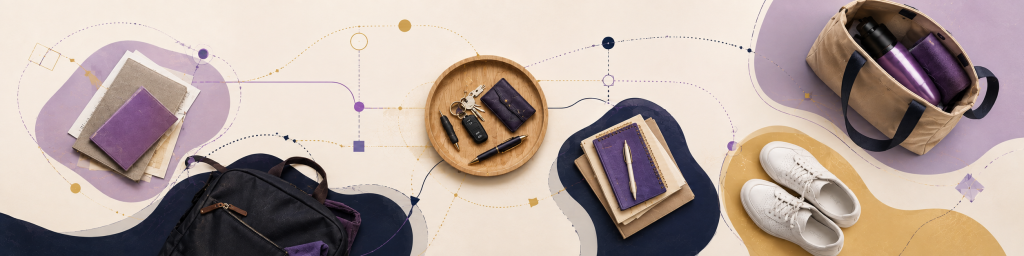
How to Make a Room Feel Less Overwhelming Without Clearing Everything Out
A room can feel like too much even when it is not filthy, packed wall to wall, or in need of a makeover. Sometimes the real problem is how much the space asks you to notice, navigate, remember, and deal with at the same time.
The Real Problem
A room can feel overwhelming without actually being a mess
Learning how to make a room feel less overwhelming does not have to begin with getting rid of half your belongings. A room can hold things you use, need, enjoy, or simply do not have another place for and still become easier to take in.
What often makes a space feel exhausting is not one dramatic problem. It is the accumulation of small demands: several unrelated things in view, objects waiting for a decision, surfaces with no room left to use, and pathways that make you adjust your body every time you move through them.
The goal here is not an empty room. It is a room that asks less of your attention while still supporting what actually happens there.
Quick Answer
Make the room ask less of your attention at once
If a room feels overwhelming, look at how many separate things are competing for your attention from one normal position. Group what belongs together, move unfinished tasks out of the main visual field, protect enough open space for the room to function, and leave visible only what benefits from being seen.
You do not have to clear everything out. You need fewer things asking for your attention at the same time.
Why It Feels Like Too Much
Room overwhelm usually comes from more than the amount of stuff
Before assuming you need a major declutter, notice what your eyes and body are dealing with. Three conditions can make a room feel much busier than its actual size or object count would suggest.
Small objects, packages, cords, papers, containers, supplies, and unrelated groups all register separately instead of reading as a few clear areas.
Returns, laundry, bags, repairs, paperwork, projects, and things waiting to leave quietly turn the room into a list of jobs that have not been completed yet.
When every seat, surface, shelf edge, pathway, or landing point is already occupied, normal actions begin requiring extra movement and adjustment.
Start With One View
Quiet one sightline instead of trying to calm the whole room
Stand or sit where the room bothers you most. It might be what you see from the bed, the chair you use at night, the doorway, the place where you eat, or the spot where you spend the most time.
Now look only at that view. What are the first five things your attention jumps toward?
You may notice a bright package on a shelf, a pile of paper, a bag waiting to leave, several small containers on a surface, clothing draped over furniture, or a group of unrelated objects that seem to demand equal attention.
You do not need to fix the entire room. Start by making one normal view easier to take in.
Try this: choose the view you see most often and reduce only the things competing inside that frame.
Reduce Separate Signals
Give your eyes fewer individual things to process
Ten useful objects do not always have to look like ten separate interruptions.
If several things are already used together, let them read as one group. A stack of active notebooks can become one working group. Charging cords that serve the same area can share one clear boundary. Supplies for one activity can stay together instead of appearing on several different surfaces.
The point is not to hide everything. It is to reduce unnecessary visual fragmentation.
Keep objects for one activity close enough that your eye reads them as one working group.
Refills, duplicates, packaging, and rarely used extras do not need the same visibility as the active item.
A little blank space helps prevent several useful areas from visually merging into one continuous mass.
A room can feel surprisingly busy because of many small unrelated objects rather than one large item.
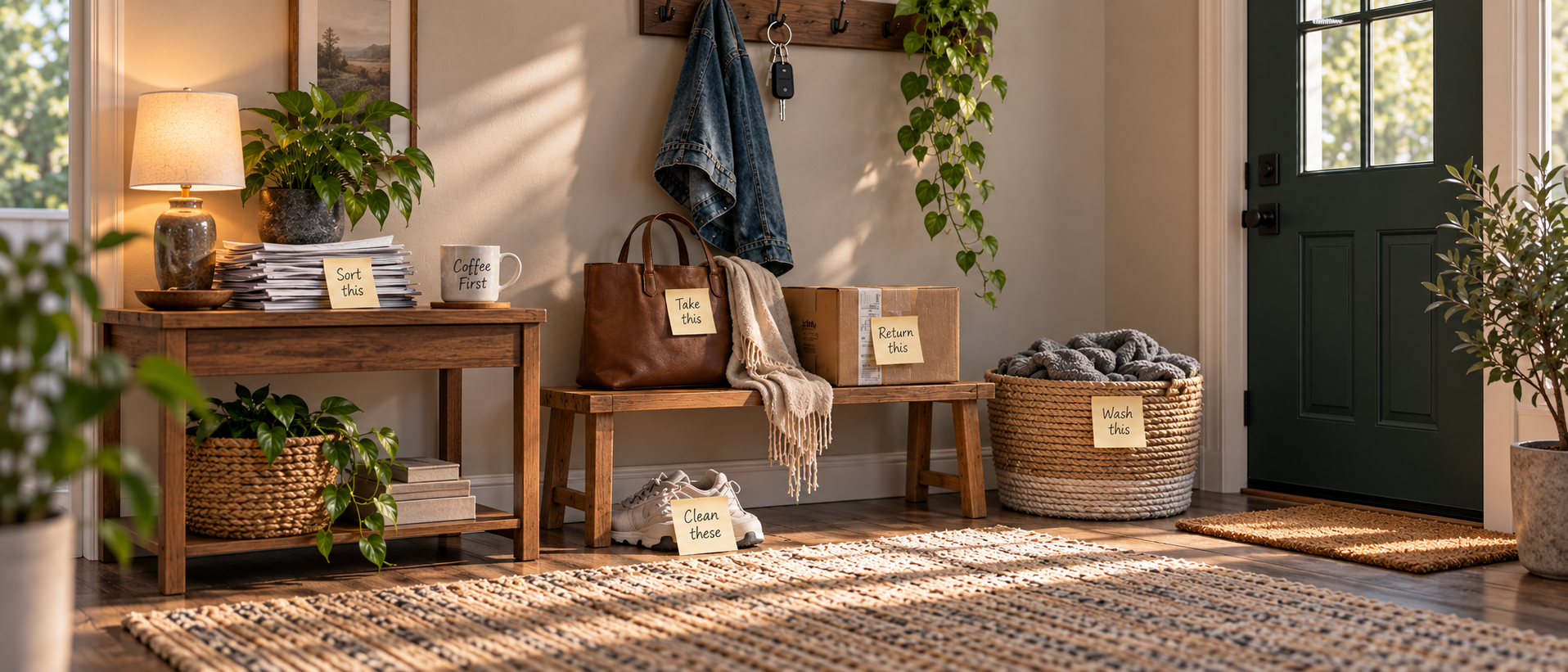
Unfinished Signals
Stop letting the room act like a giant to-do list
Some visible objects are harder to ignore because they are not just objects. They represent something you still need to do.
The package reminds you to make a return. The bag needs to go with you tomorrow. Laundry needs another step. Papers need a decision. A broken item waits for repair. A half-finished project keeps asking to be picked up again.
A few visible reminders can be useful. A room full of them can make it difficult to mentally settle because almost everything you look at carries an unfinished instruction.
Give unfinished things a limited place based on what happens next. That might be one outgoing area, one active-project boundary, one place for items waiting on a decision, or one temporary spot for returns and repairs.
The room should support your tasks. It should not have to display every task at the same time.
Protect Usable Space
Leave open space where an action needs to happen
Empty space is not wasted space.
A clear patch of counter gives you somewhere to prepare something. An open section of floor lets you move without sidestepping. A chair that is ready to sit in removes one small decision. A little clearance on a shelf lets you take something out without rearranging everything around it.
When every available inch is used for holding something, the room loses the space needed for actual activity.
Instead of asking, “What else can fit here?” ask, “What needs to happen here without moving something first?”
Should be ready for sitting without first relocating clothes, bags, books, or supplies.
Should let you move naturally without turning sideways or stepping around objects.
Needs enough open room for the action that happens there, not just more storage.
Needs enough clearance that a useful object can be removed and returned without rearranging everything.
Visibility Has a Job
Decide what actually deserves to stay visible
Hiding everything is not the answer either.
Some things are easier to use when you can see them. A medication case, dog leash, current book, active project, frequently used tool, reminder, or everyday supply may deserve visibility because seeing it helps you remember, use, enjoy, or complete something.
The useful question is not “Can I hide this?”
Does seeing this help me use it, remember it, enjoy it, or finish something important?
If the answer is yes, visibility may be useful.
If it is visible only because it has nowhere else to go, it is still in packaging, it is a backup, it belongs to a later task, or it has simply become part of the scenery, it may be taking visual attention without giving much back.
When the Room Is Overloaded
Sometimes the room itself is being asked to do too much
A bedroom may also be a hobby room, dressing area, reading space, storage area, exercise spot, and place to handle paperwork. A shared living room may hold several people’s belongings and several different kinds of daily activity.
In that situation, the problem is not always that you have “too much stuff.” The room may simply be supporting more jobs than its size can comfortably separate.
Look for one activity that can become more contained, one supply group that can move out of the main sightline, or one job that does not need to occupy the room all day.
This matters especially in small homes, rentals, shared spaces, bedrooms that hold most of one person’s belongings, and rooms with limited built-in storage.
The goal is not to make a hard-working room look empty. It is to stop every job from being visually active at the same time.
Room Overwhelm Scan
Use one normal view to find what is demanding the most attention
Sit or stand where you normally experience the room. Do not clean first. Look at the space as it usually is and answer these six questions.
The loudest thing may be a pile, bright package, crowded surface, hanging item, open door, or unfinished project.
Books, laundry, paperwork, hobby supplies, cords, shoes, toiletries, bags, and storage may all be competing in the same view.
Notice anything waiting to be returned, washed, repaired, moved, answered, delivered, donated, or decided.
Look for a seat you cannot sit in, a surface you cannot use, or a path that requires you to move around something.
Pay attention to repeated sidestepping, reaching over, lifting, shifting, squeezing past, or putting something somewhere temporarily.
Keep sight of what helps you use, remember, enjoy, or finish something. Question the things that are visible for no useful reason.
Pick the loudest answer. Work on that one first instead of turning the entire room into a project.
Important Distinction
Empty is not the goal
A useful room can still contain books, art supplies, blankets, clothing, plants, equipment, collections, reminders, and the ordinary signs of a life being lived.
The difference is whether those things leave enough physical and visual breathing room for the space to do its job.
Your eye can land somewhere without immediately meeting another competing group.
Your body can move, sit, reach, open, set something down, or use the area without first clearing an obstacle.
Not every visible object is asking you to remember, finish, sort, move, or deal with something.
The room can return to a usable state without a long reset after ordinary use.
When Simplifying the View Is Not Enough
Sometimes the problem is the space you have to work with
Not every overwhelming room can be solved by arranging things more cleverly. Some spaces are carrying real constraints, and pretending otherwise just turns the problem into a personal failure.
A bedroom or studio may have to support sleeping, dressing, storage, hobbies, paperwork, and downtime. The goal may be clearer separation between jobs rather than a sparse-looking room.
Different people may need different things visible, reachable, or close at hand. A solution that looks quieter for one person may make the room harder for someone else to use.
You may not be able to add built-ins, change fixtures, mount heavy storage, or replace furniture. Work with visibility, grouping, clearance, and temporary boundaries instead.
A visually hidden item is not an improvement if accessing it requires uncomfortable reaching, bending, lifting, or extra movement.
A room can feel visually and physically overloaded because large pieces interrupt movement or sightlines even when the amount of stored stuff is reasonable.
If the broader problem is physical friction rather than visual overwhelm alone, use the Improve Your Space hub to find the space problem that fits better.
Why This Works
Visual clutter is more than a simple item count
A 2026 study in the Journal of Vision examined how item quantity, spatial organization, and surface complexity contribute to visual clutter. The researchers found that clutter is multifaceted rather than being explained by the number of objects alone.
That helps explain why making a room feel less overwhelming is not always about removing possessions. How objects are grouped, arranged, and presented in the visual field can change how cluttered a scene appears. Read the visual clutter study.
FAQ
Common questions about making a room feel less overwhelming
These answers cover the questions that usually come up when a room feels visually or physically like too much but clearing everything out is not realistic or useful.
Why does my room feel overwhelming even after I declutter?
A room can still feel overwhelming when many unrelated groups remain visible, unfinished tasks are spread throughout the space, surfaces are visually busy, or there is not enough open room for normal actions. Object count is only part of what creates visual clutter.
How can I make a room feel less cluttered without getting rid of things?
Group things that are already used together, move backups and packaging out of the main sightline, contain unfinished tasks in limited areas, preserve some genuinely open space, and reduce the number of unrelated groups visible from the places where you spend the most time.
Should everything be hidden to make a room feel calmer?
No. Frequently used or important items may work better when they remain visible. The goal is useful visibility, not hiding everything.
Can a small room feel calmer even if it holds a lot?
Yes. A small room may still feel easier to take in when object groups are clear, unfinished tasks are contained, movement paths remain usable, and every surface is not competing for attention at once.
Why do unfinished tasks make a room feel overwhelming?
A return package, laundry basket, paperwork, repair, or active project can repeatedly cue something that still needs attention. When many of those signals are visible at once, the room can begin to feel like a list of pending tasks.
How much empty space should a room have?
There is no universal percentage. What matters is whether there is enough open room for the actions that happen there. You should be able to sit, move, reach, open, set something down, and use important surfaces without repeatedly shifting other objects first.
What should I change first when a room feels overwhelming?
Choose the normal view that bothers you most and identify the loudest source of competition in that view. Change that one source before expanding the project.
Next Path
Keep improving the problem you actually have.
If this room needs more than visual breathing room, follow the next path that matches what is getting in the way.