Routine Paths Guide
How to Build a Routine That Fits Your Real Life
Learning how to build a routine gets easier when you stop designing for perfect days and start building around your real energy, schedule, friction, and restart points.
If you are trying to figure out how to build a routine that actually works, start with the day you really have, not the day you wish you had.
Most routines are built around one hidden assumption: “I’ll do this when life is calmer.” That is where they start to break.
A routine can look simple, healthy, productive, or motivating and still be a poor fit for your actual week. It may ask for too much energy in the wrong window, too many decisions before you are ready, or a perfect stretch of time your life rarely gives you.
That does not mean you are bad at routines. It means the routine may have been designed for ideal conditions instead of normal ones.
A routine that fits your real life has a clear anchor, a repeatable first step, a bad-day version, and a restart cue so missing one day does not turn into starting over.
The full routine is not the first routine.
If the simple version cannot survive a normal day, adding more steps will not fix it.
Quick Answer
How do you build a routine that fits your real life?
To build a routine that fits your real life, start with one normal-day anchor, one repeatable step, one bad-day version, and one restart cue. Then adjust the routine around your actual energy, timing, decision load, and friction instead of forcing a perfect schedule.
A routine that fits does not need to work the exact same way every day. It needs a version you can start on a normal day, a smaller version you can use when life gets messy, and a clear way back in when you miss a day. Research on habit formation points to repeated behavior in a stable context, which is why a clear cue or anchor can make a routine easier to repeat. Read more about habit formation.
Example: if your evening reset keeps failing because it starts too late, the fix may not be more discipline. The fix may be moving the first step earlier, shrinking the routine to one surface, and using “after dinner” as the anchor instead of “before bed.”

Normal Day Check
Why routines fall apart on ordinary days
A routine can make perfect sense when you plan it from a quiet moment. Then the real day shows up with work, errands, interruptions, low energy, decisions, dinner, messages, clutter, and everything else already asking for your attention.
That is usually where the routine breaks. Not because the idea was bad, and not because you failed. The routine was built for a cleaner version of the day than the one you actually live.
A morning routine that asks you to choose a workout, make breakfast, journal, tidy up, and plan the day may be too heavy before work. An evening routine that starts after you are already drained may never get a fair chance.
A routine that fits has to work before the day is perfect. It needs a clear way to begin, enough room for interruption, and a smaller version that still counts.
Check what the routine asks from an ordinary day.
If the first step depends on quiet, time, and planning, the routine may be too hard to start.
A routine that needs focus after your focus is gone will keep feeling harder than it should.
If one interruption ruins the whole thing, the routine needs a pause point.
The smaller version keeps the routine alive when the ordinary day gets crowded.
Decision: if the routine needs the day to stay clean, shrink it before you try to repeat it.
Friction Check
Find the part of the routine that is creating drag
When a routine is hard to repeat, the whole routine is not always the problem. Often, one part of the routine is carrying too much weight.
The friction might happen before the routine begins, when the first step is vague. It might happen while the routine is underway, when the order asks for too many decisions. It might happen because the timing does not match your energy. Or it might happen because the routine takes effort but does not make the day meaningfully easier.
That is why a friction check matters. It helps you change the right part of the routine instead of rebuilding the entire routine every time it slips.
A useful routine is not just repeatable. It is designed so the hardest part is easier to reach.
Match the fix to the part of the routine that is actually breaking.
-
Entry
The routine is hard to begin
The first step is too vague, too easy to delay, or buried behind a decision like what to do first.
Fix Choose the first action before the routine window arrives. -
Sequence
The order creates resistance
The routine asks you to think, choose, switch tasks, or solve problems before momentum has started.
Fix Move the easiest action first so the routine has an entry ramp. -
Timing
The routine is in the wrong window
The routine needs focus, patience, movement, or planning at a time when that energy is usually low.
Fix Move the routine, shorten it, or change what the window is responsible for. -
Payoff
The routine does not give enough back
The routine may be technically productive, but it does not reduce stress, decisions, mess, delay, or tomorrow’s burden.
Fix Keep the part that creates relief and remove the part that only adds pressure.
What the Routine Asks For
Count the routine’s demands before you expect it to stick
Every routine asks something from your day. It may ask for time, focus, planning, emotional bandwidth, movement, quiet, or the ability to switch from one mode into another.
That ask matters. A routine can be useful and still be too expensive for the window you are putting it in. Before you judge your consistency, check what the routine is actually requiring.
Does the routine need ten minutes, thirty minutes, or an open-ended block? A routine is easier to repeat when the time container is clear.
Does it ask for physical effort, mental focus, patience, planning, or emotional steadiness? Those are different kinds of energy.
Does the routine make you choose what to do next? Too many choices can turn a helpful routine into another task to manage.
How hard is it to move into the routine from whatever came before it? The switch itself may be the hidden demand.
Does one missed step make the whole routine feel off track? If the order is too fragile, the routine needs more flexibility.
Does the routine leave room for a tired day, a late start, or a shorter version? A routine with no margin is harder to keep alive.
Can you tell when the routine is complete? A clear finish helps the routine feel satisfying instead of endless.
If the ask is heavier than the window can hold, the routine will feel harder than it should. The fix is not always to try harder. Sometimes the fix is to reduce the demand, move the routine, or define a smaller version that still does the job.
What the Routine Gives Back
Match the routine to the pressure it is supposed to reduce
A routine should do more than make your day look organized. It should make one part of your life feel easier to move through.
This is where a lot of routines get too vague. “I want a better morning routine” can mean too many things. A clearer target would be, “I want fewer rushed choices before work,” “I want evenings to stop spilling into bedtime,” or “I want one reliable way to reset the house before tomorrow.”
When you know what the routine is meant to relieve, you can tell whether it is actually helping or just adding another thing to keep up with.
Name the return before you decide whether the routine is worth keeping.
The routine closes open loops so you are not carrying the same unfinished thought all day.
The routine handles a decision you keep having to remake, like what happens after work, before bed, or before you leave the house.
The routine gives you a clear first action so you are not stuck staring at the whole task at once.
The routine gives you a bridge between work and home, morning and day, or scattered energy and the next useful thing.
The routine helps one part of the day close instead of dragging its mess, stress, or decisions into the next part.
The routine narrows the next step so everything does not feel open, urgent, and competing at the same time.
The routine leaves proof that something moved forward, even if the day was messy or unfinished.
The routine gives you one place in the day that feels familiar, even when the rest of the schedule changes.
If the routine asks for effort but does not make a real pressure point lighter, it is not earning its place yet. Keep the part that helps. Shrink or replace the part that only adds another obligation.
Smallest Useful Version
How to build a routine you can actually test
The next step in how to build a routine is not adding more pieces. It is finding the smallest version that still does the job.
A useful small routine is not a fake version or a failure version. It is the version that lets you see whether the routine actually helps before you turn it into a bigger system.
Compress the routine into a version you can use on normal days and bad days.
The smallest useful version should keep the core benefit. It should still reduce the pressure, support the transition, or make the next step easier.
The full version may include too much
- More steps than the window can hold.
- Choices that slow the routine before it starts.
- Extra tasks that feel productive but do not carry the main benefit.
- A finish line that is unclear or too far away.
The useful version keeps the core job
- One anchor that tells you when to begin.
- One first action that removes the entry drag.
- One result that makes the day easier in a noticeable way.
- One clear stopping point and one restart cue for the next time you miss it.
Keep the step that actually lowers pressure, creates clarity, or makes the next transition easier.
Cut the extra step that makes the routine feel more complete but does not make it more useful.
Try the smallest useful version before deciding whether the routine needs more structure.
The smallest useful version is the routine’s first proof. If that version helps, you can build from it. If it does not help, adding more steps will probably make the routine heavier, not better.
Small Test
Test the routine before you build your life around it
It is easy for a routine idea to get too big before it ever proves useful. One simple change can turn into a full morning plan, an evening reset, a tracking system, and a list of rules you now feel responsible for keeping.
The small test keeps the routine honest. You are not trying to prove that you can follow the perfect routine. You are trying to learn whether one usable version actually helps the day feel easier.
A small test gives you real information before the routine becomes another thing to maintain.
Make the first test narrow enough to teach you something.
The test should not answer, “Can I become a completely different person?” It should answer one practical question about one routine window.
Good test question: did this small version make the next part of my day easier? If the answer is yes, you have something to build from. If the answer is no, you have something specific to adjust.
Attach it to a moment that already happens, then keep the action short enough that the test can actually happen.
Do not add more steps yet. A second try helps you see whether the routine itself works, or whether the first day was just unusual.
Move the time, shorten the action, change the order, or make the first step clearer. Do not rebuild the whole routine yet.
Did the cue feel natural? A good anchor should feel easy to notice, not like another thing to remember.
Was the timing realistic? The routine should fit the energy you usually have in that part of the day.
Where did it slow down? Look for the exact moment the routine became harder than it needed to be.
What got easier afterward? The routine should reduce a real pressure point, even in a small way.
The first test does not need to decide everything. It only needs to show whether this version makes your actual day easier in a way you can notice.
Decision
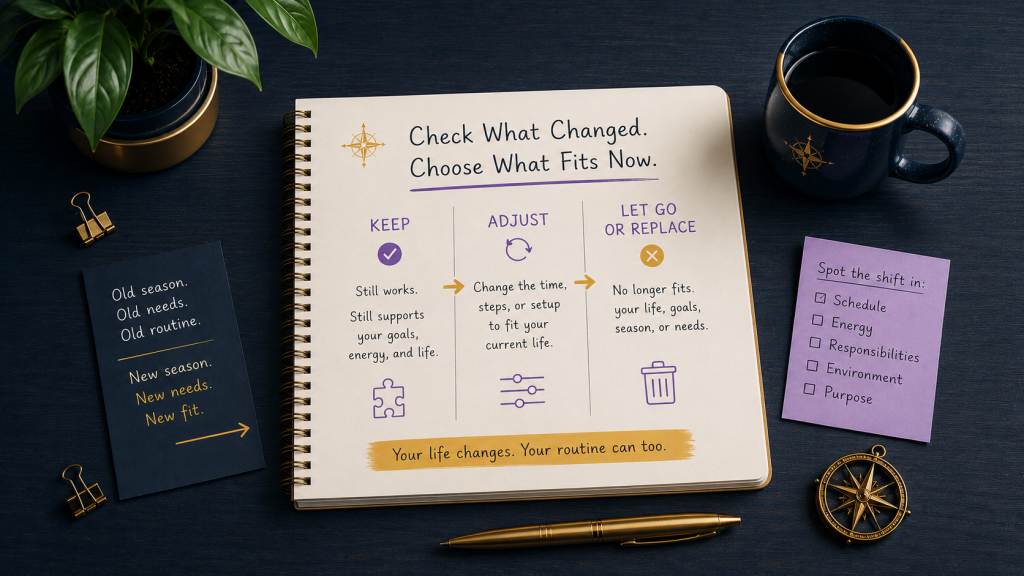
Decide whether to keep, shrink, move, replace, or let it go
After you test a small version, do not turn the result into a verdict on your discipline. The test is feedback. It shows what the routine needs next.
Sometimes the routine is working and should stay simple. Sometimes it is useful, but too large. Sometimes the idea is right, but the time is wrong. And sometimes the routine is solving the wrong problem.
The final step in how to build a routine is choosing the next adjustment instead of starting over from guilt.
After the test, choose the path that matches the evidence.
You do not need a dramatic reset. You need the next honest move: keep, shrink, move, replace, or let it go.
Keep it
Use this when the routine helped without making the day heavier. Keep the version that worked before adding more steps.
Shrink it
Use this when the routine helped, but asked too much. Keep the useful part and remove the extra step that made it harder to repeat.
Move it
Use this when the routine is right, but the window is wrong. Try it at a time when your energy, attention, or schedule gives it a fair chance.
Replace it
Use this when the routine is not solving the pressure point. Choose a different action that makes the same part of the day easier.
Let it go
Use this when the routine gives too little back for what it asks. Letting it go is not failure. It is choosing a better fit.
Use the test as feedback, not a verdict on you.
-
What actually got easier?
Look for a real return, such as less rushing, fewer choices, a smoother transition, or a clearer next step.
-
Where did the routine drag?
Notice whether the problem was timing, length, decision load, unclear order, or the first step.
-
What is the smallest useful adjustment?
Change one thing before you rebuild the whole routine.
-
Would I choose this version again?
If the answer is no, the routine may need to shrink, move, change shape, or leave the plan.
A routine that fits your real life does not need to be perfect. It needs to make one part of the day easier, repeatable, and worth returning to.
Common Mistakes
What makes routines harder to keep than they need to be
Routines usually get harder when they are built from pressure instead of function. The routine starts as a way to make life easier, but then it grows into another thing to manage.
That does not mean you are bad at routines. It means the routine may be asking too much, starting in the wrong place, or solving a problem you do not actually have.
-
Mistake OneBuilding the full version first
A routine can become too heavy when you add every helpful idea at once. More steps may look better on paper, but they also create more places for the routine to break.
Better moveStart with the job. Keep the step that creates the return, then add more only after the simple version proves useful.
-
Mistake TwoGiving the routine no clear anchor
If the routine depends on remembering it from scratch, it has to fight for attention every time. That makes the routine feel optional, even when it would help.
Better moveAttach it to an existing moment. Coffee, getting home, dinner cleanup, opening your laptop, or brushing your teeth can become the cue.
-
Mistake ThreePutting the routine in the wrong energy window
Some routines fail because they ask for focus, patience, movement, or planning at the exact time you usually have the least of it.
Better moveMove the routine or change the demand. The right routine in the wrong window will still feel harder than it should.
-
Mistake FourMaking the full version the only version that counts
When a routine only feels valid if every step happens, one missed piece can make the whole thing feel ruined. That turns a useful structure into an all-or-nothing test.
Better moveDefine what still counts. A bad-day version keeps the routine alive without pretending every day has the same capacity.
-
Mistake FiveKeeping a routine that does not give enough back
A routine can be productive and still not be useful. If it does not reduce rushing, decisions, stress, mess, delay, or tomorrow’s burden, it may not be earning its place.
Better moveCheck the return. Keep the part that makes life easier and remove the part that only adds pressure.
A routine should get easier to use as you test it. Every adjustment should remove drag, clarify the next step, or make the routine fit the day you are actually living.
FAQ
Questions people ask when they are trying to build a routine
These are the questions that usually come up when a routine sounds helpful, but you are trying to make it work with your actual time, energy, schedule, and normal day.
Quick answers before you build your next routine
What is the best way to build a routine?
The best way to build a routine is to start with one real pressure point in your day, then create a small repeatable action that helps with that problem. A good routine should have a clear anchor, a realistic time window, a simple first step, and a useful return, such as fewer decisions, less rushing, or an easier transition.
Why do routines fail so quickly?
Routines often fail because they are built for ideal days instead of normal days. They ask for too much time, energy, focus, or decision-making in a window that cannot support it. If a routine keeps failing, check the friction point before you blame your discipline.
How small should a new routine be?
A new routine should be small enough to test without needing a perfect day. That might mean ten minutes, one prepared item, one reset, one first step, or one short sequence. The routine is big enough when it creates a noticeable benefit, not when it looks impressive.
What should I do if I miss a routine?
If you miss a routine, use a restart cue instead of starting over from guilt. Ask what made the routine hard to reach, then choose the next usable version. You may need to shrink the routine, move it to another time, or define a bad-day version that still counts.
How long does it take to build a routine?
There is no perfect number of days that makes every routine automatic. A routine becomes easier to repeat when it fits the right window, reduces a real pressure point, and has a clear enough first step. Focus less on streaks and more on whether the routine is becoming easier to return to.
How do I know if a routine is actually working?
A routine is working if it makes one part of your day easier in a way you can notice. It may reduce rushing, lower decision fatigue, create a smoother transition, make tomorrow easier, or give you one steady point in the day. If it only adds pressure, it needs to change.
Next Step
You do not need a perfect routine. You need one useful next version.
Learning how to build a routine gets easier when you stop treating every missed day like proof that you failed. Start with the day you actually live, notice what the routine asks from you, and test one version that makes a real part of life easier.
A routine that fits does not have to control your whole day. It just has to give you one steadier place to begin, return, or reset.
Keep the routine usable.
- Choose one pressure point the routine should reduce.
- Test the smallest version that still helps.
- Keep, shrink, move, replace, or let it go after the test.