Why You Can’t Stick to a Routine
If you are asking why you can’t stick to a routine, the problem may not be discipline. The routine may be breaking at one specific point: the start, the time window, the decision moment, the bad-day version, or the return.
Start Point → Breaking Point → Restart Cue
Problem
Why you can’t stick to a routine may come down to where the routine breaks.
When you wonder why you can’t stick to a routine, look for the place where the same pattern keeps falling apart.
You might avoid starting it, start too late, get stuck deciding what comes next, or miss one day and feel like the whole thing is ruined.
That pattern matters. The routine is not just “not working.” It is giving you information about the part that is too hard to repeat.
Better starting point: do not ask, “Why can’t I be consistent?” Ask, “Where does this routine actually break?”
Quick Answer
If you can’t stick to a routine, diagnose the failure pattern first.
To fix a routine you can’t stick to, find the first repeatable breaking point. The routine may start too late, begin with a decision, depend on a mood you rarely have, require the full version, or offer no clear next move after disruption.
Once you know the pattern, you can repair that part instead of rebuilding the entire routine.

Fit Lens
Why routines fail: look for the pattern before you change the plan.
When a routine does not stick, it is tempting to look for a better routine, a stricter routine, or a more motivating routine.
Most broken routines have a pattern. The plan may fail before it begins, at the same time of day, whenever you are tired, or the moment you have to decide what to do next.
This article is a troubleshooting guide for that pattern. If you need the bigger routine foundation after this, the Build Better Routines hub is the better next stop.
Diagnostic Map
Why you can’t stick to a routine usually starts with one of these breaking points.
Use these categories to name the problem before you try to fix it.
The routine is placed after your energy, attention, or available time is already gone.
You know the routine matters, but nothing in your environment makes the first move easy to notice.
The routine asks you to choose what to do at the exact moment you need the least friction.
There is no smaller version for tired, busy, interrupted, or low-focus days.
The routine only works when you feel motivated, calm, rested, organized, or already ahead.
After one missed day, the routine has no clear way back in, so restarting feels too big.
How to Use This List
These routine problems are clues, not personal flaws.
You are not trying to become a different person in this article. You are trying to locate the weak point in a routine that already keeps breaking. Once you can name that point, the fix gets smaller and more practical.
Troubleshooting
Reasons you can’t stick to a routine and what to repair first
Start with the reason that sounds most familiar. Each one points to a different repair, so you are not stuck using the same advice for every routine problem.
If the routine starts too late
If you can’t stick to a routine because it starts too late, move the trigger earlier.
Some routines fail because they begin after the useful window has already closed. A bedtime routine that starts when you are exhausted is not really a bedtime routine. It is a last-minute rescue attempt.
The same problem can show up with morning resets, meal prep, workouts, cleaning routines, or planning routines. If the plan starts when you are already rushed, irritated, hungry, or checked out, the timing is doing too much damage.
Repair first: move the trigger earlier than the crash point. If your bedtime routine keeps failing at 10:30, test one small cue after dinner instead: fill the water bottle, plug in your phone, or place tomorrow’s first item where you will see it.
If the first step is not visible
If your routine does not stick, make the starting cue easier to see.
A routine is easier to forget when the first step lives in your head instead of your environment. You may fully intend to do it, but nothing in the room reminds your body where to begin.
This is why routines often disappear during normal days. The cue is too quiet. Supplies are put away, and the first action is hidden behind a cabinet, app, closet, drawer, or vague intention.
Repair first: make the first step visible before the routine window arrives. Put walking shoes by the door, the notebook on the counter, the water bottle beside the coffee maker, or the cleaning cloth on the surface you want to reset.
If the routine begins with a decision
If you can’t keep a routine, remove the choice that keeps slowing you down.
Many routines fail because they start with “figure out what to do.” That sounds harmless, but choosing creates drag. The more tired or busy you are, the more expensive that choice becomes.
If your plan starts with deciding which workout, which meal, which chore, which task, which notebook, or which order, your brain has to solve the routine before it can do the routine.
Repair first: pre-decide the first move and keep it boring. Change “work out after work” into “put shoes on and walk for five minutes after closing the laptop.” Change “figure out lunch” into one default lunch formula.
If the full version is the only version
If you can’t stick to a routine on bad days, create the version that still counts.
A routine becomes fragile when only the full version counts. Forty minutes counts, but five minutes does not. A full kitchen reset counts, but clearing one counter does not. A complete morning routine counts, but one useful action does not.
That turns normal interruptions into failure points. The routine has no smaller door, so when the full version is not possible, there is no way in.
Repair first: name the smallest version that still keeps the path alive. Full workout equals 40 minutes. Messy-day version equals shoes on and five minutes of movement. Full reset equals the kitchen. Messy-day version equals the counter beside the sink.
If the routine depends on a mood
If your routine only works when you feel ready, lower the emotional requirement.
Some routines only work when you feel calm, motivated, rested, focused, confident, or already organized. That makes the routine dependent on a state you may not have when the routine is supposed to happen.
This is different from laziness. The routine is asking for an emotional condition before it can begin.
Repair first: make the first action neutral enough to do without the mood. Do not start with “feel motivated to plan the week.” Start with “open the planner to tomorrow.” Do not start with “feel like cleaning.” Start with “throw away visible trash.”
If the routine solves the wrong problem
If a routine keeps falling apart, check whether it actually reduces pressure.
A routine can look productive and still not help. A planning routine can create more lists without making tomorrow easier. A cleaning routine can target the wrong area. A morning routine can look impressive while ignoring the real bottleneck.
When the routine does not give anything useful back, it becomes another task to carry.
Repair first: ask what pressure the routine is supposed to reduce. If the problem is chaotic mornings, the useful routine may not be a long morning routine. It may be one evening cue that makes the first 10 minutes easier.
If the routine was copied from someone else’s life
If you can’t stick to a copied routine, remove the parts that do not match your day.
Copied routines can fail quietly because they were built for someone else’s schedule, home, energy, work, family, body, or season of life.
The routine may not be bad. It may just be carrying assumptions that do not belong to your day. Early wakeups, long quiet blocks, perfect prep time, empty counters, and uninterrupted evenings are not available to everyone.
Repair first: keep the goal and change the shape. If someone else’s morning routine is built around an hour of quiet, but your mornings are rushed, borrow the intention, not the schedule. Choose one anchor that your morning can actually hold.
If there is no next move after disruption
If one missed day ruins the routine, give yourself a return point.
Many routines do not fail on the missed day. They fail after the missed day because there is no clear return point.
Without a next move, one skipped morning can become a week. One busy evening can become a full reset. The routine starts to feel like something you have to restart from the beginning.
Repair first: choose the first move after disruption. If you miss the morning plan, the return point might be “after work, reset one surface.” If you miss a workout, it might be “next day, put shoes on and walk for five minutes.”
Be Careful With
Why routine advice can make the problem worse
If you use the wrong fix, the routine may keep failing for the same reason. Be careful with advice that skips diagnosis and jumps straight into more pressure.
- “Just be consistent”: consistency is the outcome. It does not tell you where the routine is breaking.
- “Wake up earlier”: this may make the problem worse if sleep, mornings, or energy are already the weak point.
- “Make a checklist”: a checklist can help, but not if the routine begins too late or has too many decisions.
- “Track every day”: tracking can become another routine that fails before the original one is stable.
- “Never miss a day”: this makes the routine more fragile because normal life will interrupt it eventually.
- “Copy a successful person’s routine”: their routine may depend on a life structure you do not have.
Habit research often points back to cues, repetition, and automaticity, which is why a routine usually needs a clear trigger instead of relying only on motivation. For more background, you can read this overview on the psychology of habit formation.
Small Test
A 10-minute test when you can’t stick to a routine
Use this before you quit the routine completely. The goal is to find the breaking point, not redesign your whole life.
Choose the routine that has the clearest pattern, not the one you feel most guilty about.
Does it fail before you start, when the time arrives, when you have to choose, when you are tired, or after one missed day?
Move the trigger earlier, make the cue visible, remove one decision, create a smaller version, or add a return point.
Do not judge it from one perfect day or one bad day. Three tries gives you better information.
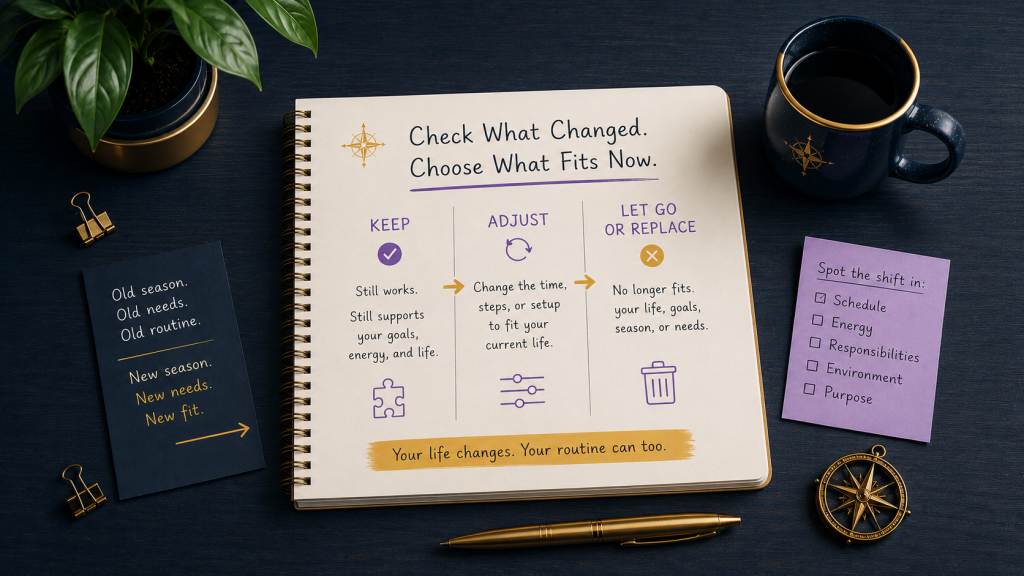
Keep it, shrink it, move it, replace it, or let it go. The point is to learn from the break.
FAQ
Common questions about why you can’t stick to a routine
Use these answers when you are trying to understand why a routine keeps breaking in the same place.
Why can’t I stick to a routine?
You may not be able to stick to a routine because it has a repeatable breaking point. It may start too late, begin with a decision, depend on motivation, require the full version, or lack a clear return point after disruption.
Is it a discipline problem if I keep quitting routines?
Not always. If the routine keeps failing in the same place, the first step is diagnosis. A discipline problem and a routine design problem can feel similar, but they need different repairs.
What should I do when I miss a routine?
Use a return point instead of a full reset. Choose one small next move that brings you back into the routine, such as opening the notebook, clearing one surface, putting on shoes, or setting up tomorrow’s first cue.
How small should a routine be?
A routine should be small enough to begin on a normal day. If the full version only works when you are rested, motivated, and uninterrupted, create a smaller version that still keeps the path open.
How do I know if a routine is worth keeping?
A routine is worth keeping if it solves the right problem and gives something useful back. If it adds pressure without making life easier, it may need to be simplified, moved, or replaced.